

The Mind-Body Connection: Why a Broader View of Healing Means We Treat One Nervous System

The short version: At Vistas, we see mind and body as one nervous system, shaped in relationship. That's why our Registered Psychotherapists work from both directions: top-down through conversation and meaning, and bottom-up through gentle, body-aware practice. It's also why we offer mindfulness, yoga, naturopathic, and massage care as separate services alongside psychotherapy, in Toronto, Ottawa, and virtually across Ontario.
It feels like someone is driving.
Somewhere behind your eyes, a voice plans the day, weighs the options, and makes the calls. It's easy to picture that voice as the pilot, and the body as the plane: a vehicle that carries you around and occasionally makes alarming noises.
It's a convincing picture. It's also not quite how you're built.
Our whole approach at Vistas rests on a simpler idea. You have one nervous system, and your brain is part of it. That nervous system is shaped not only inside you, but between you and the people around you.
This post explains where the pilot idea came from, why it feels so true, and what changes in therapy when we set it down. It's also the reason behind our motto: a broader view of healing.
Where the split between mind and body came from
In the 1600s, the philosopher René Descartes argued that mind and body were two different kinds of thing. The body was a machine: physical, measurable, open to study. The mind, or soul, was something else entirely.
Descartes genuinely believed in the soul, so this wasn't only a strategy. But the timing mattered. He was writing when the church took a close and sometimes dangerous interest in scientific claims. In 1633, Galileo was condemned for his astronomy, and Descartes quietly shelved his own book on the physical world.
Dualism worked as a kind of truce. The church kept the soul. Science got the body. Everyone could get on with their work.
That truce was useful for a long time. It also left us with a habit that never quite went away: treating mental health and physical health as two separate departments, with two separate front doors.
Why the pilot feels so real: meet the narrator
If the split is an inherited habit, why does it feel so true?
Part of the answer is the prefrontal cortex, the region behind your forehead that handles planning, language, and reflection. In evolutionary terms, it's the newest kid on the block. It's also the last part of the brain to finish developing, often not until our mid-twenties. Because our running commentary lives there, it's easy to assume it's in charge.
Research suggests it's often less of a pilot and more of a narrator.
Some of the clearest evidence comes from split-brain studies. Beginning in the 1960s, researchers including Roger Sperry and Michael Gazzaniga worked with people who had surgery to separate the two halves of the brain as a treatment for severe epilepsy. With the connection cut, researchers could show information to one hemisphere at a time.
In one experiment Gazzaniga describes, a participant's left hemisphere saw a chicken claw, and his right hemisphere saw a snowy scene. Each hand then chose a matching picture. The left hand, guided by the right hemisphere, picked a snow shovel. The right hand picked a chicken.
Asked why, the verbal left hemisphere, which had never seen the snow, answered without missing a beat: you need a shovel to clean out the chicken shed.
Fluent. Confident. Entirely made up.
Gazzaniga called this the interpreter: a system in the left hemisphere that builds a tidy story to explain what we do, whether or not it knows the real reasons.
A note in fairness: none of this means there are "left-brained" and "right-brained" people. A large brain-imaging study found no sign that people favour one hemisphere overall. More recent research also suggests some split-brain patients have more unified awareness than the early studies implied. The interpreter finding has held up well. The pop-psychology version hasn't.
Why we know better and still don't do better
Most of us know the gap between knowing better and doing better.
You know the presentation will probably go fine, and your stomach still drops. You know the argument ended days ago, and your shoulders are still up near your ears. You know exactly what you'd say to a friend, and you can't seem to say it to yourself.
None of this means you're weak, stubborn, or doing it wrong. It means the narrator is narrating while much of the real action happens elsewhere in the system: in heart rate and breath, in the gut, and in patterns learned long before you had words for them. (If stress shows up for you more in the body than as worry, this post on why anxiety doesn't always feel like anxiety goes deeper.)
The neuroscientist Antonio Damasio made a version of this case in Descartes' Error (1994). His work suggested that signals from the body aren't noise that reason has to push past. They're part of how reasoning works. People with damage to brain areas that integrate those body signals could often still reason well on paper, yet struggled to make sound decisions in their own lives.
The narrator can be loud, and sometimes harsh. If yours tends toward criticism, we've written about why the inner critic gets so loud and how to calm it.
One nervous system
We work from a simple frame: you have one nervous system, and your brain is part of it.
Your brain is not a magical orb floating in your skull, directing traffic from somewhere outside the body. It is body: living tissue, made of cells, fed by blood, wired into everything else. It makes up about 2% of your body weight and uses roughly 20% of your energy. Less a pilot, more a very hungry organ.
Thinking of the brain as separate from the nerves running through the rest of you is a bit like thinking of the heart as separate from the circulatory system. The heart matters enormously. But it doesn't work alone, it isn't the whole system, and you can't understand it without the vessels it's connected to.
That connection runs in two directions.
Every thought and feeling has a physical side. This is why a polygraph registers a change when someone answers a hard question. It doesn't detect lies; it detects arousal, such as shifts in heart rate, breathing, and sweat. It's also why your pupils widen when something interests you or you're concentrating hard. What happens in the mind happens in the body, because there's nowhere else for it to happen.
Much of the traffic runs upward. The vagus nerve, a major highway between the brain and the organs, carries far more signals up from the body than down from the brain. Your body is constantly reporting in, and those reports shape mood, attention, and what feels safe.
Your brain is also constantly reading your body. A region called the insula helps pull together signals from your heart, lungs, gut, and skin into a felt sense of how you're doing, a process researchers call interoception. It's remarkable, and it isn't perfect. The brain is always making its best guess about what those signals mean, and sometimes it guesses wrong: a racing heart from one coffee too many can register as dread, and a knot in your stomach can feel like a warning about something that's actually fine. Then the narrator steps in to explain it.
The heart needs its vessels. The brain needs the rest of the nervous system. And, as it turns out, the whole system needs other people.
One nervous system, shaped in relationship
Our nervous systems are shaped not only inside us, but between us.
Psychiatrist Dan Siegel describes the mind as both embodied and relational. It lives throughout the body, and it's shaped between people. Our nervous systems are built to respond to one another: to a calm voice, a familiar face, the feeling of being understood.
We learn this early. Babies settle by being settled by someone else, which researchers call co-regulation. (We looked at what new research says about how everyday distractions can interrupt those moments between parents and infants.) Adults never fully outgrow the need for it. We just get better at hiding how much we rely on it.
If a heart is never really alone in the body, a nervous system is never really alone in the world.
That changes how we see therapy. The relationship isn't just the room where the work happens. It's part of the work. A steady, attuned relationship gives a stressed nervous system something to lean on until it can find that steadiness more on its own.
It's also why our clinicians pay attention to the relationships, families, communities, and cultures you live within, not only to what's happening inside you.
What this means in therapy: top-down and bottom-up
If the heart and its vessels are one system, you'd care for both. Therapy works the same way.
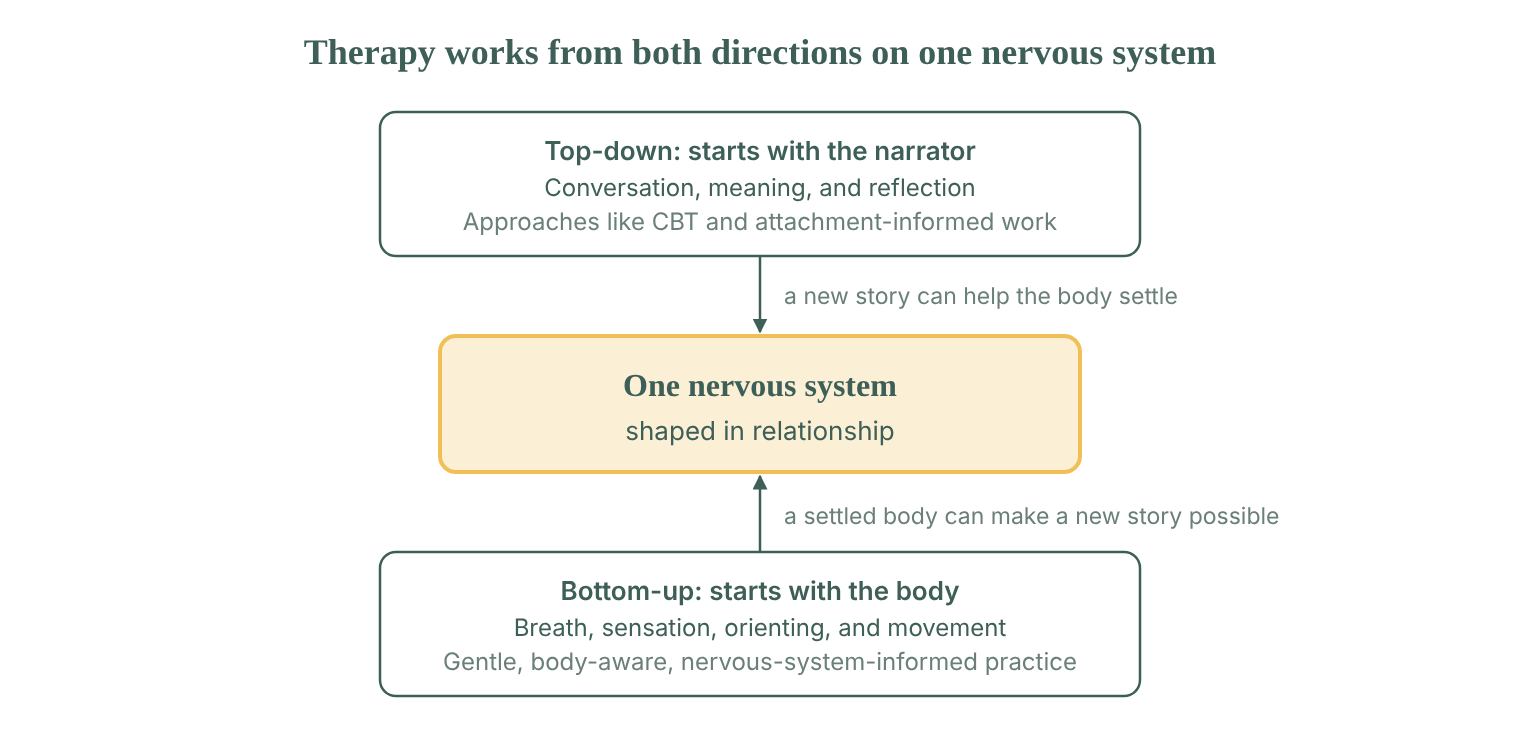
Top-down work starts with the narrator. Talking things through, making meaning, noticing patterns, and reconsidering old beliefs. Approaches like cognitive behavioural therapy live here, and they matter.
Bottom-up work starts with the body. Breath, posture, sensation, movement, grounding, and noticing what shifts physically as you talk. This is the heart of nervous-system-informed therapy.
Most of the time, our clinicians weave the two together. Sometimes a new story helps the body settle. Sometimes the body needs to settle before a new story feels possible.
We do not offer formal somatic modalities, bodywork, or touch-based interventions in psychotherapy. Body-aware practices in our sessions stay gentle, optional, and within the scope of talk therapy.
And because the nervous system is tissue, it responds the way tissue does: to manageable practice, repeated over time. Think of it less as a quick fix and more like strength training. You build capacity gradually, with rest between efforts, and nobody starts with the heaviest weight in the gym. In therapy language, that's widening your window of tolerance at a pace your system can actually take.
What we mean by integrative therapy
"Integrative therapy" appears on a lot of therapist websites. It's rarely explained.
Here's what we mean. Integrative doesn't mean a little bit of everything. It means drawing on several well-researched approaches, organized by one clear rationale, and fitted to the person in the room. For us, that rationale is the one nervous system. Different tools, same system, much like caring for a heart through its rhythm, its vessels, and the life around it.
How we organize the work
- The window of tolerance. Siegel's term for the range where you can feel things without being flooded or shutting down. It guides pacing: when to go deeper, and when to steady first.
- Phase-oriented care. Especially with trauma, the work tends to move from safety and steadiness, to working through what happened, to bringing those changes into daily life. The phases overlap, and we revisit them as needed.
- Two directions, one system. We move between top-down and bottom-up work, depending on what your system can use that day.
Top-down approaches we draw from
- Cognitive behavioural therapy (CBT): noticing thought patterns and testing them against experience.
- DBT-informed skills: practical tools for riding out strong emotions and steadying in hard moments.
- Psychodynamic ideas: how early relationships can shape the patterns we repeat now.
- Schema and ego-state-informed work: understanding different "parts" of us as patterns learned in earlier experience, each with its own logic.
Bottom-up practices we draw from
- Breath and pacing, such as lengthening the exhale.
- Orienting and grounding through the senses and the space around you.
- Body awareness, gently noticing sensations like tightness, warmth, or heaviness as you talk.
- Mindfulness practices that build the capacity to notice without immediately reacting.
- Yoga-informed movement and posture, always gentle and optional.
Approaches that bridge both
EMDR may be explored when appropriate, with readiness assessed together. It works with memory, body sensation, and meaning at the same time, which makes it a natural fit for a one-nervous-system approach. You can read more in our guide to EMDR therapy.
Not every clinician uses every approach. Each works within their own training, and together you'll decide what fits your goals. You don't need to know any of these names before you start.
That's integrative therapy as we mean it: many tools, one system, chosen with you.
A broader view of healing
Seeing mind and body as one system is the reason Vistas offers more than talk therapy.
If we were only minds, talk therapy might be the whole story. But we have one nervous system, living in a body and shaped in relationship. So we think healing deserves a broader view, one that doesn't treat a single model as one-size-fits-all.
That's why, alongside psychotherapy, Vistas offers mindfulness and meditation coaching and individual yoga instruction, and our wider team includes a naturopathic doctor (ND) and a registered massage therapist. Each one meets the nervous system from a different direction.
A few things matter to us here:
- Each is its own service. Yoga instruction, mindfulness coaching, naturopathic care, and massage therapy are not psychotherapy, and they're booked and billed separately. Naturopathic and massage care are provided by practitioners regulated by their own professions.
- Nothing is required. Psychotherapy stands on its own. You can add other supports, or not, and you can change your mind.
- Your information stays yours. Practitioners coordinate with each other only with your consent.
What this offers you is a team that thinks about the whole system, a pace set by you, and options under one roof if and when you want them. You can see everything we offer on our Services and Fees page.
Common questions
What is mind-body therapy? Mind-body therapy is an approach to psychotherapy that treats thoughts, emotions, and body responses as parts of one connected nervous system. At Vistas, it means working top-down, through conversation and meaning, and bottom-up, through gentle, body-aware practices like breath, grounding, and noticing sensation.
What does "nervous-system-informed therapy" mean? It's psychotherapy that treats mind and body as one connected system. Alongside talk therapy, our clinicians pay gentle attention to breath, sensation, and grounding, so the work happens from the top down and the bottom up.
What's the difference between top-down and bottom-up approaches? Top-down approaches start with thoughts, meaning, and language. Bottom-up approaches start with the body's signals, such as breath, posture, and sensation. Many people benefit from a mix, and the balance can shift over time.
What does integrative therapy mean at Vistas? It means drawing on several well-researched approaches, such as CBT, DBT-informed skills, psychodynamic ideas, EMDR, mindfulness, and body-aware practices, organized by one rationale: we have one nervous system, shaped in relationship. Your clinician fits the approach to you, rather than fitting you to a single model.
Will I have to do body-based exercises in therapy? No. Body-aware practices are always offered, never required. Some sessions are mostly conversation, and you decide what feels right.
Do I need to use yoga, naturopathy, or massage therapy alongside psychotherapy? No. These are separate services that some people choose to add. Psychotherapy is complete on its own.
Where can I access this kind of therapy in Ontario? Vistas offers in-person sessions in Toronto and Ottawa, and virtual sessions anywhere in Ontario.
Your next step
If this way of thinking about healing resonates, you're welcome to book a free consultation or use our Find Your Fit page to explore which clinician might suit you.
The narrator will probably have opinions about it. That's fine. Bring it along.
Further Reading & Sources
If you'd like to learn more about the mind-body connection and the research behind this approach, these resources offer additional depth:
- Damasio, A. R. (1994). Descartes' error: Emotion, reason, and the human brain. G. P. Putnam's Sons. The case that body signals are central to reasoning and decision-making.
- Gazzaniga, M. S. (2000). Cerebral specialization and interhemispheric communication: Does the corpus callosum enable the human condition? Brain, 123(7), 1293–1326. https://doi.org/10.1093/brain/123.7.1293. A review of split-brain research, including the interpreter.
- Gazzaniga, M. S. (2011). Who's in charge? Free will and the science of the brain. Ecco. An accessible account of the interpreter and the chicken-and-shovel experiment.
- Pinto, Y., Neville, D. A., Otten, M., Corballis, P. M., Lamme, V. A. F., de Haan, E. H. F., Foschi, N., & Fabri, M. (2017). Split brain: Divided perception but undivided consciousness. Brain, 140(5), 1231–1237. https://doi.org/10.1093/brain/aww358. Newer findings that complicate the classic split-brain picture.
- Nielsen, J. A., Zielinski, B. A., Ferguson, M. A., Lainhart, J. E., & Anderson, J. S. (2013). An evaluation of the left-brain vs. right-brain hypothesis with resting state functional connectivity magnetic resonance imaging. PLOS ONE, 8(8), e71275. https://doi.org/10.1371/journal.pone.0071275. Evidence against "left-brained" and "right-brained" personality types.
- Arain, M., Haque, M., Johal, L., Mathur, P., Nel, W., Rais, A., Sandhu, R., & Sharma, S. (2013). Maturation of the adolescent brain. Neuropsychiatric Disease and Treatment, 9, 449–461. https://doi.org/10.2147/NDT.S39776. On the prefrontal cortex's late development.
- Raichle, M. E., & Gusnard, D. A. (2002). Appraising the brain's energy budget. Proceedings of the National Academy of Sciences, 99(16), 10237–10239. https://doi.org/10.1073/pnas.172399499. The source for the brain's share of the body's energy.
- Breit, S., Kupferberg, A., Rogler, G., & Hasler, G. (2018). Vagus nerve as modulator of the brain–gut axis in psychiatric and inflammatory disorders. Frontiers in Psychiatry, 9, 44. https://doi.org/10.3389/fpsyt.2018.00044. On the vagus nerve's mostly upward (afferent) signalling.
- Hess, E. H., & Polt, J. M. (1960). Pupil size as related to interest value of visual stimuli. Science, 132(3423), 349–350. https://doi.org/10.1126/science.132.3423.349. The classic study on pupils and interest.
- Siegel, D. J. (2012). Pocket guide to interpersonal neurobiology: An integrative handbook of the mind. W. W. Norton. Siegel's account of the mind as embodied and relational.
- Herman, J. L. (1992). Trauma and recovery. Basic Books. The source of the phase-oriented model of trauma care.
- Linehan, M. M. (2015). DBT skills training manual (2nd ed.). Guilford Press. The core DBT skills for emotion regulation and distress tolerance.
- Shapiro, F. (2018). Eye movement desensitization and reprocessing (EMDR) therapy: Basic principles, protocols, and procedures (3rd ed.). Guilford Press. The foundational EMDR text.
- Khalsa, S. S., Adolphs, R., Cameron, O. G., Critchley, H. D., Davenport, P. W., Feinstein, J. S., et al. (2018). Interoception and mental health: A roadmap. Biological Psychiatry: Cognitive Neuroscience and Neuroimaging, 3(6), 501–513. https://doi.org/10.1016/j.bpsc.2017.12.004. Research on how sensing the body's internal state relates to mental health.
- Craig, A. D. (2009). How do you feel—now? The anterior insula and human awareness. Nature Reviews Neuroscience, 10(1), 59–70. https://doi.org/10.1038/nrn2555. On the insula's role in turning body signals into felt experience.
- Barrett, L. F., & Simmons, W. K. (2015). Interoceptive predictions in the brain. Nature Reviews Neuroscience, 16(7), 419–429. https://doi.org/10.1038/nrn3950. On how the brain predicts, and sometimes misreads, what the body is signalling.
This post offers general information for educational purposes. It is not therapy, does not replace individualized mental-health care, and does not establish a therapeutic relationship. If you're experiencing distress or need support, please connect with a qualified mental-health professional in your area. If you are in immediate distress or at risk of harm, in Canada you can call or text 9-8-8 (Suicide Crisis Helpline) or call 9-1-1, and internationally you can visit FindAHelpline.com to locate free, confidential support services available in your specific country and language.