

Fall Back, Feel Low? Daylight Saving Time, Mood, and Your Self-Care Plan

The short version: When the clocks fall back on Sunday, November 1, 2026, evenings in most of Ontario get dark an hour earlier. Less light can lower energy and mood, and research has found a rise in depressive episodes after the switch to standard time. A simple plan for before and after the change, built around morning light, a steady wake time, movement, and connection, can make the adjustment gentler.
Every year, around the first week of November, something shifts.
Work feels heavier. Your relationship feels a little shakier. The to-do list starts to feel personal. You find yourself wondering whether it's time to change everything.
It might be. Or it might be 4:58 p.m. and already dark.
Ask a few therapists and many will tell you the same thing: practices tend to be quieter through the summer and into September, then the phones start ringing again right around the time the clocks fall back. That's an observation from the field, not a research finding, but it's a consistent one.
It's also why, over the years, I've made a habit of reminding the people I work with about how much changes in light can affect mental health, and helping them plan ahead before November arrives. This post is that reminder, for you.
What changes when the clocks fall back
At 2 a.m. on Sunday, November 1, most of Ontario sets the clocks back an hour. (Ontario has announced plans to keep communities in the northwest that follow Central Time on daylight time year-round.) The extra hour of sleep is lovely. The trade-off is that evenings go dark an hour earlier, overnight. For many people, the commute home, the dog walk, and dinner now all happen in the dark.
Think of daylight as a dimmer switch. Since June, the season has been turning it down so slowly you barely noticed. The clock change is different. It takes the light you had after work and switches it off in a single weekend.
Why less light can lower your mood
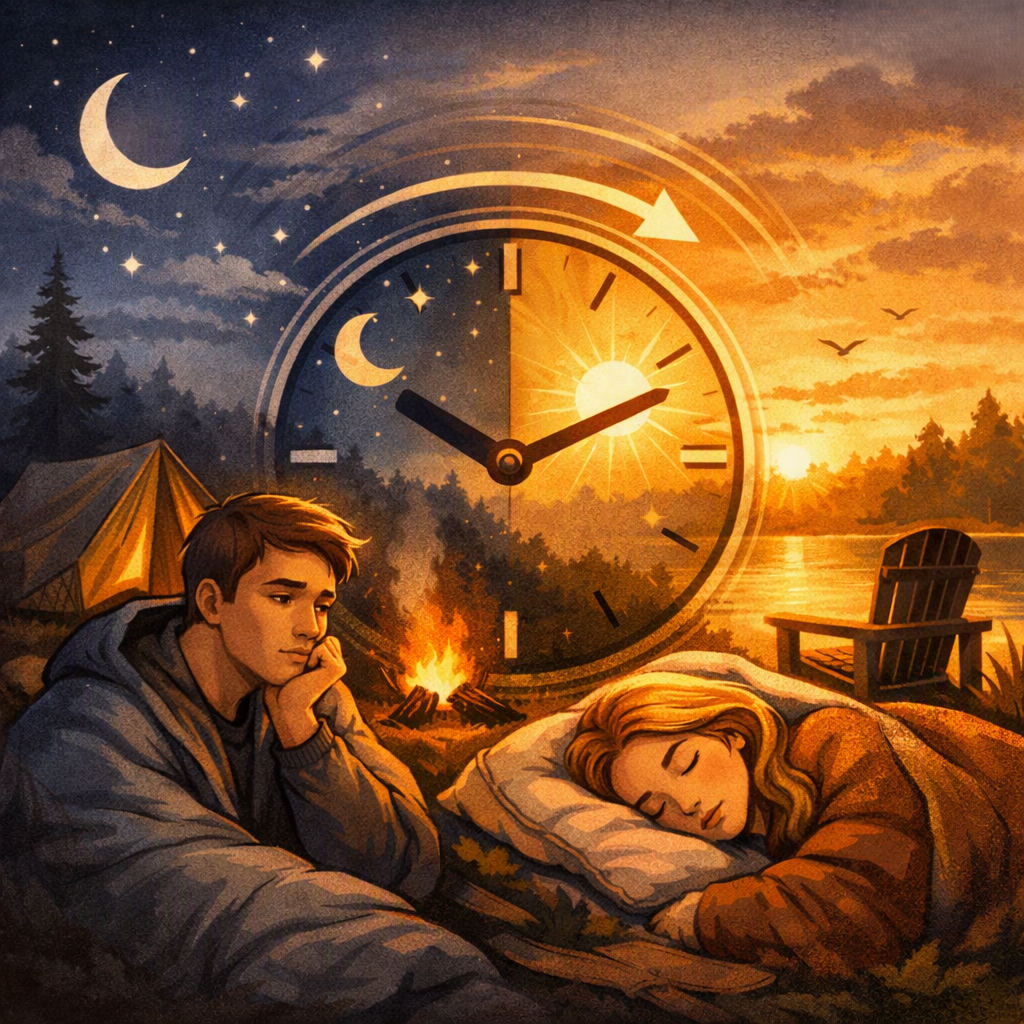
Light is the main signal your body uses to set its internal clock, the circadian rhythm that helps regulate sleep, energy, appetite, and mood. In one study, researchers took people camping with no artificial light, and their body clocks shifted after about a week to line up with sunrise and sunset. Your nervous system pays close attention to light, whether you do or not.
When light drops, many people feel sleepier, lower in energy, hungrier for carbs, and less interested in plans. One large Danish study found that diagnoses of depressive episodes rose by about 11% right after the switch to standard time, then gradually eased over the following weeks. It's one study and it shows a pattern, not a cause, but it fits what many people notice in themselves.
In Canada, the Canadian Mental Health Association estimates that about 15% of people experience the "winter blues," and about 2–3% experience seasonal affective disorder (SAD), a form of depression linked to the darker months.
Why we blame our lives instead of the light
Here's where it gets sneaky.
When your body feels low, the thinking part of your brain wants to explain why. Research on what neuroscientist Michael Gazzaniga called the brain's interpreter shows how readily we invent confident explanations for what we feel, whether or not we know the real reason.
Here's one way to picture it. Your body notices the change: less light, lower energy, a heavier mood. Your brain wants to know why. So it's as if the interpreter yanks open a filing drawer, grabs the most convenient file, and blames your mood on whatever is inside it: your job, your partner, your body, yourself.
That file might hold real stress. But it may not be the cause. The interpreter rarely reaches for the one labelled It's November and I just lost an hour of evening light.
If stress tends to show up in your body before your mind catches up, you might also like Why Stress and Anxiety Doesn't Always Feel Like "Anxiety".
That doesn't mean the stress in your life isn't real. You may genuinely have a lot going on. Less light can simply turn up the volume on what's already there.
A useful question in early November: Would I feel this way in June? If the answer is "probably not," it may be worth holding big decisions a little more loosely for a few weeks.
Your self-care plan: before the clocks change
The week before is the time to set things up, while you still have the energy to plan.
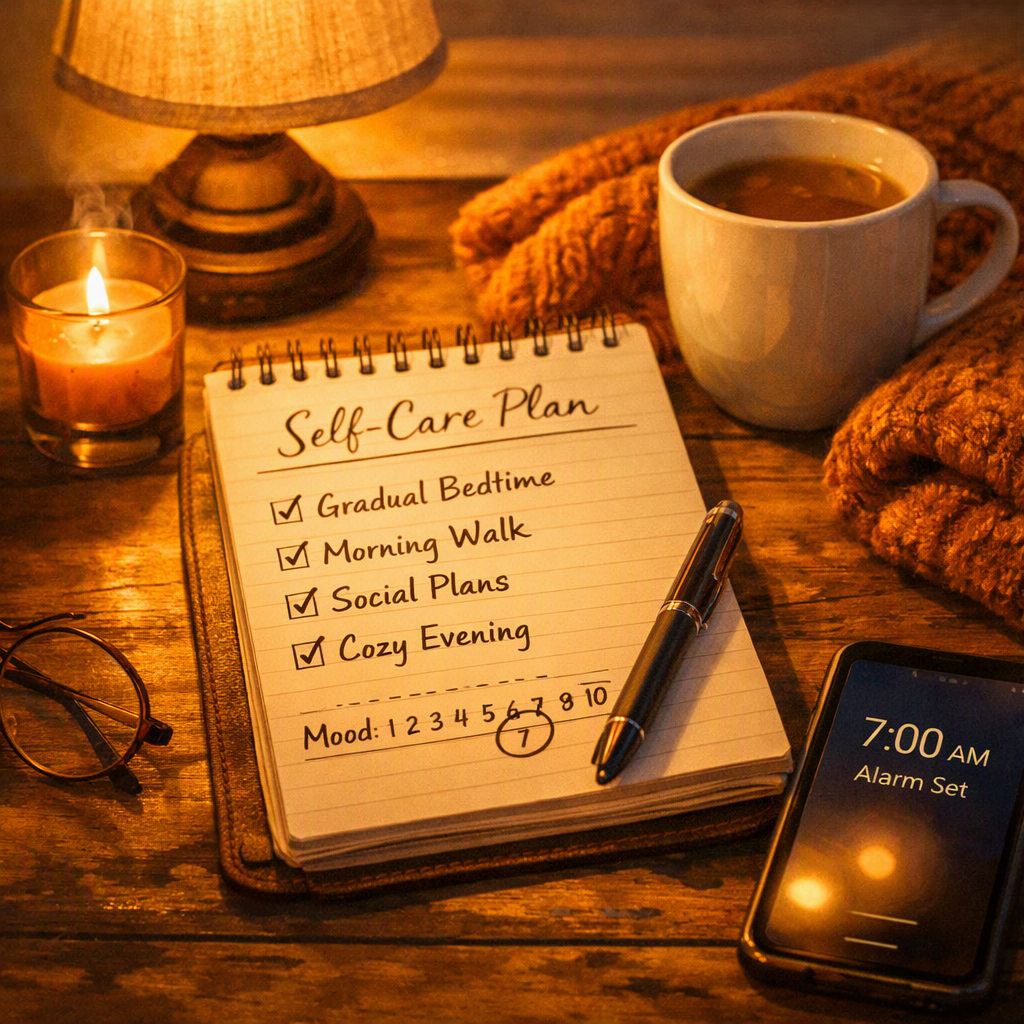
- Ease into it. For a few days before the change, try going to bed and getting up about 15 minutes later each day. Your body will feel less jolted when the clocks fall back.
- Book your light. Choose a daily window to get outside in daylight after the change, like a morning walk or a lunchtime loop. Put it in your calendar now, as if it were a meeting.
- Plan your evenings. Dark doesn't have to mean shut down. Line up a few evening things you look forward to: a class, a phone call, a cozy project, a standing dinner with someone.
- Schedule connection. Make a couple of social plans for the first two weeks of November, when motivation tends to dip.
- Brighten your space. Add brighter lamps to the rooms you use in the morning.
- Take a baseline. Rate your mood and energy from 1 to 10 this week and write it down. In a few weeks, you'll have something to compare against besides your interpreter's opinion.
Your self-care plan: after the clocks change
For the first few weeks of November, treat yourself like someone adjusting to a new time zone.
- Get morning light. Try to get outside within an hour or so of waking, even on cloudy days. Outdoor light is far brighter than indoor light.
- Keep your wake time steady, weekends included. Oversleeping can make the winter blues worse, even though bed feels like the only place that understands you.
- Move, ideally outside. Movement in daylight does double duty.
- Name the season first. When you feel low, try "This might be the light" before "This is my life."
- Lower the bar a little. For a couple of weeks, your nervous system is recalibrating. It's a reasonable time to do slightly less.
- Check your baseline. Compare your mood and energy with what you wrote down before the change.
If any of these don't fit your life or feel uncomfortable, skip them. That's useful information too.
When it's more than the winter blues
It's worth talking to your doctor or a mental health professional if low mood lasts more than two weeks, if you've lost interest in things you usually enjoy, or if it's getting in the way of work, relationships, or daily life. Depression with a seasonal pattern is well recognized, and support is available.
In therapy, our clinicians work from both directions. Top-down, that can mean noticing the stories your mind tells about the season and testing them, using approaches like cognitive behavioural therapy. Bottom-up, it can mean building routines around light, movement, and rest that help your body find steadier ground, which is the heart of nervous-system-informed therapy.
Vistas offers therapy for depression and low mood in person in Toronto and Ottawa, and virtually across Ontario.
Common questions
When does daylight saving time end in Ontario in 2026? On Sunday, November 1, 2026, at 2 a.m., when clocks move back one hour. Ontario has announced plans for communities in the northwest that follow Central Time to stay on daylight time.
Does the end of daylight saving time affect mood? It can. When the clocks fall back, evenings get dark an hour earlier, and less light can affect sleep, energy, and mood. Research has found a rise in depressive episodes after the switch to standard time, although not everyone is affected.
How can I prepare for the end of daylight saving time? In the week before, shift your bedtime and wake time about 15 minutes later each day, schedule daily time outdoors in daylight, and plan a few evening activities and social plans for early November. Afterwards, get morning light, keep a steady wake time, and move your body, ideally outside.
What's the difference between the winter blues and seasonal affective disorder? The winter blues are a milder dip in mood and energy during the darker months, and about 15% of people in Canada experience them. Seasonal affective disorder (SAD) is a form of depression that affects about 2–3% of people in Canada and can significantly interfere with daily life. Only certain regulated professionals, such as a family doctor, nurse practitioner, or psychologist, can diagnose SAD. A Registered Psychotherapist can help you make sense of what you're experiencing and work on it with you.
How long does it take to adjust to the time change? Sleep usually adjusts within a few days to a week. The effects of shorter days on mood can last longer, through the darker months.
Should I use a light therapy lamp? Some people find light therapy helpful, and it has research support for seasonal depression. Talk to your doctor before starting, especially if you have bipolar disorder, an eye condition, or take medication that makes you sensitive to light.
Your next step
If November tends to hit hard, you don't have to wait until you're deep in it. You're welcome to book a consultation or explore Find Your Fit.
The dimmer switch will turn back up. In the meantime, you can bring a little light of your own.
Further Reading & Sources
If you'd like to learn more about light, mood, and seasonal changes, these resources offer additional information:
- Hansen, B. T., Sønderskov, K. M., Hageman, I., Dinesen, P. T., & Østergaard, S. D. (2017). Daylight savings time transitions and the incidence rate of unipolar depressive episodes. Epidemiology, 28(3), 346–353. https://doi.org/10.1097/EDE.0000000000000580. The Danish study on depressive episodes after the switch to standard time.
- Wright, K. P., McHill, A. W., Birks, B. R., Griffin, B. R., Rusterholz, T., & Chinoy, E. D. (2013). Entrainment of the human circadian clock to the natural light-dark cycle. Current Biology, 23(16), 1554–1558. https://doi.org/10.1016/j.cub.2013.06.039. The camping study on light and the body clock.
- Golden, R. N., Gaynes, B. N., Ekstrom, R. D., Hamer, R. M., Jacobsen, F. M., Suppes, T., Wisner, K. L., & Nemeroff, C. B. (2005). The efficacy of light therapy in the treatment of mood disorders: A review and meta-analysis of the evidence. American Journal of Psychiatry, 162(4), 656–662. https://doi.org/10.1176/appi.ajp.162.4.656. A review of the research on light therapy.
- Lam, R. W., Levitt, A. J., Levitan, R. D., Enns, M. W., Morehouse, R., Michalak, E. E., & Tam, E. M. (2006). The Can-SAD study: A randomized controlled trial of the effectiveness of light therapy and fluoxetine in patients with winter seasonal affective disorder. American Journal of Psychiatry, 163(5), 805–812. https://doi.org/10.1176/ajp.2006.163.5.805. A Canadian trial on light therapy for seasonal depression.
- Canadian Mental Health Association – Winter blues vs. seasonal affective disorder: What's the difference? Canadian figures and practical tips for the darker months.
- Gazzaniga, M. S. (2011). Who's in charge? Free will and the science of the brain. Ecco. An accessible account of the brain's interpreter.
This post offers general information for educational purposes. It is not therapy, does not replace individualized mental-health care, and does not establish a therapeutic relationship. If you're experiencing distress or need support, please connect with a qualified mental-health professional in your area. If you are in immediate distress or at risk of harm, in Canada you can call or text 9-8-8 (Suicide Crisis Helpline) or call 9-1-1, and internationally you can visit FindAHelpline.com to locate free, confidential support services available in your specific country and language.