
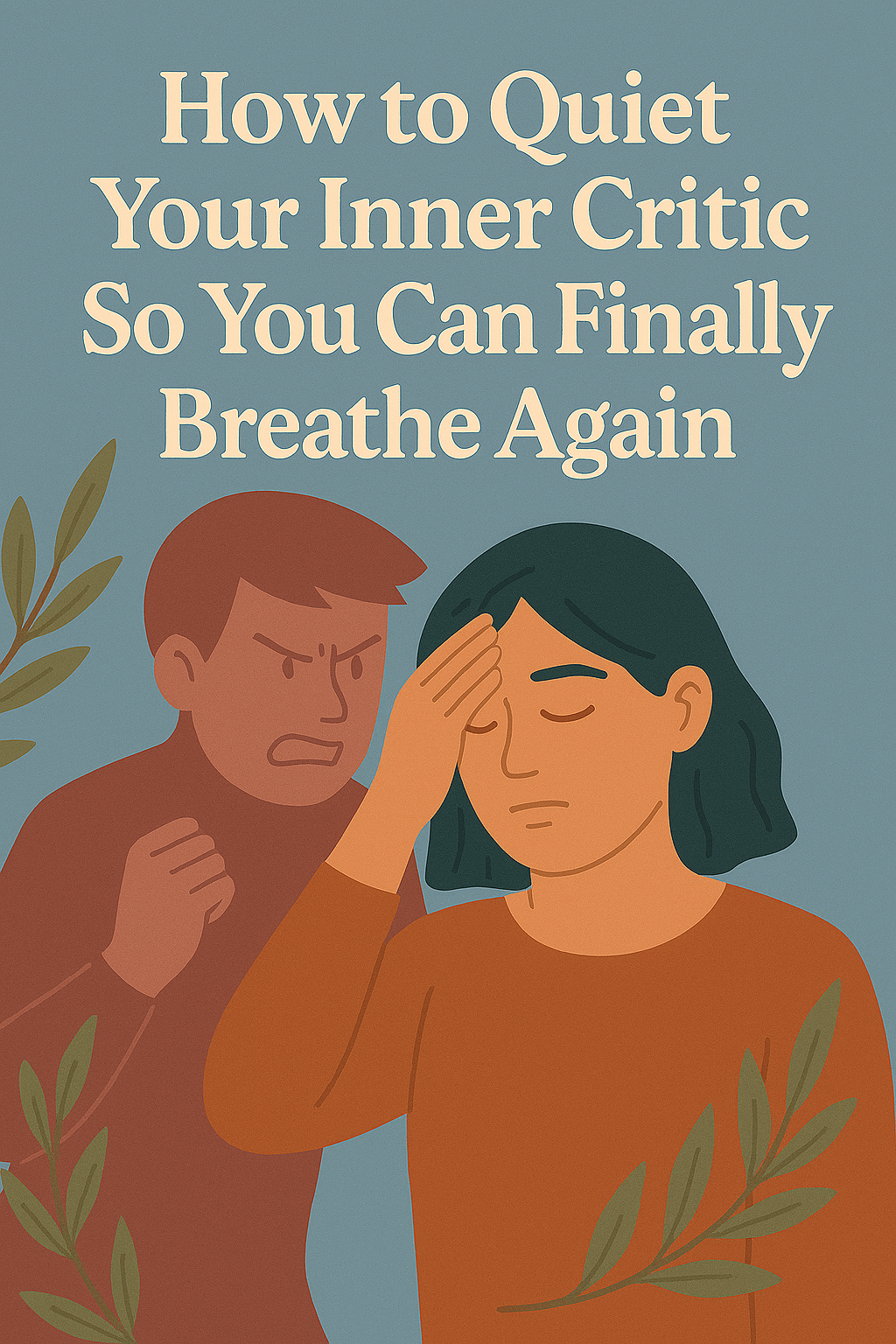
Inner Critic: Why It Gets So Loud and How to Calm It

Quick Answer: The inner critic is a common psychological pattern shaped by past experiences and protective responses. While it can feel harsh or overwhelming, many therapeutic approaches focus on understanding its role and gradually shifting how individuals relate to it through self-awareness and support.
Psst… Guess What? You’re Not the Only One With That Jerk in Your Head
This post is for educational purposes only and is not a substitute for mental health care. If you need support, please find an appropriate support in your area. Resources are listed at the bottom of this article.
Psst — guess what?
- That jerk in your head replaying every conversation you’ve ever had?
- The one who wonders what everyone really thinks of you?
- The one who watches you from the outside like a hypervigilant little cameraman, scanning for signs that someone might think you’re weird?
Guess what: we all have that voice.
If you’ve ever wondered how to stop negative self-talk or quiet your inner critic, you’re not alone—many people experience a persistent internal voice that can feel critical, overwhelming, or difficult to manage.
What is the Inner Critic?
The inner critic is a persistent internal sub-personality or "voice" that judges, demeans, or censors one’s thoughts and actions. From a neurobiological perspective, the inner critic often functions as an overactive social-safety mechanism, originating in the brain's attempt to protect the individual from perceived social rejection, shame, or loss of belonging by enforcing rigid standards of behavior.
Why We Care So Much About What Others Think
Worrying about other people’s opinions isn’t a flaw — it’s evolutionary. Humans survive in groups. For most of our history, being kicked out of the group wasn’t just embarrassing; it was dangerous. Isolation meant fewer resources, less protection, and a higher risk of harm. So our brains developed a built‑in alarm system to keep us in line with social norms — a kind of internal social radar that scans for anything that might threaten connection.
That alarm system is your inner critic.
It’s the part of you that says, “Careful — don’t do anything that might get you rejected.” It’s the part that replays conversations, second‑guesses your tone, and warns you not to be “too much” or “not enough.” It’s trying to protect you from loneliness, which we now know has real, measurable impacts on health, wellbeing, and even lifespan. Feeling connected, accepted, and understood isn’t just emotionally comforting — it’s biologically essential.
So no — having that voice doesn’t mean something is wrong with you. It means you’re human. It means your nervous system is doing its job, even if it’s a little overzealous. The inner critic isn't broken; it's using a survival strategy that was very effective for a younger version of you, even if it feels like 'too much' for the adult you are today.
But here’s the good news: you can teach it new ways to protect you. You can help it evolve. You can shift it from a panicked alarm bell into a wise, grounded advisor. And that shift starts with understanding, not exile.
Struggling with Your Inner Critic? You’re Not Alone
Take it from me: most people struggle with the exact same thing. That voice in your head? The one that nitpicks, second-guesses, and replays every awkward moment? It’s not just you.
We’re almost always kinder to others than we are to ourselves. We’ll show up for a friend without hesitation, yet feel guilty asking for support. We replay conversations and obsess over the one thing we think we said “wrong,” even though no one else noticed. We set impossible standards for ourselves and then feel ashamed when we inevitably fall short.
The problem isn’t that the voice exists — it’s when it gets too loud. When it starts to drown out your confidence, make you question your worth, and turn everyday moments into emotional landmines. The voice itself isn’t the issue; it’s the volume and the power we’ve learned to give it.
That’s when it stops being helpful and starts being harmful. And that’s when it’s time to talk back — not with anger, but with compassion.
When the Inner Critic Becomes a Bully
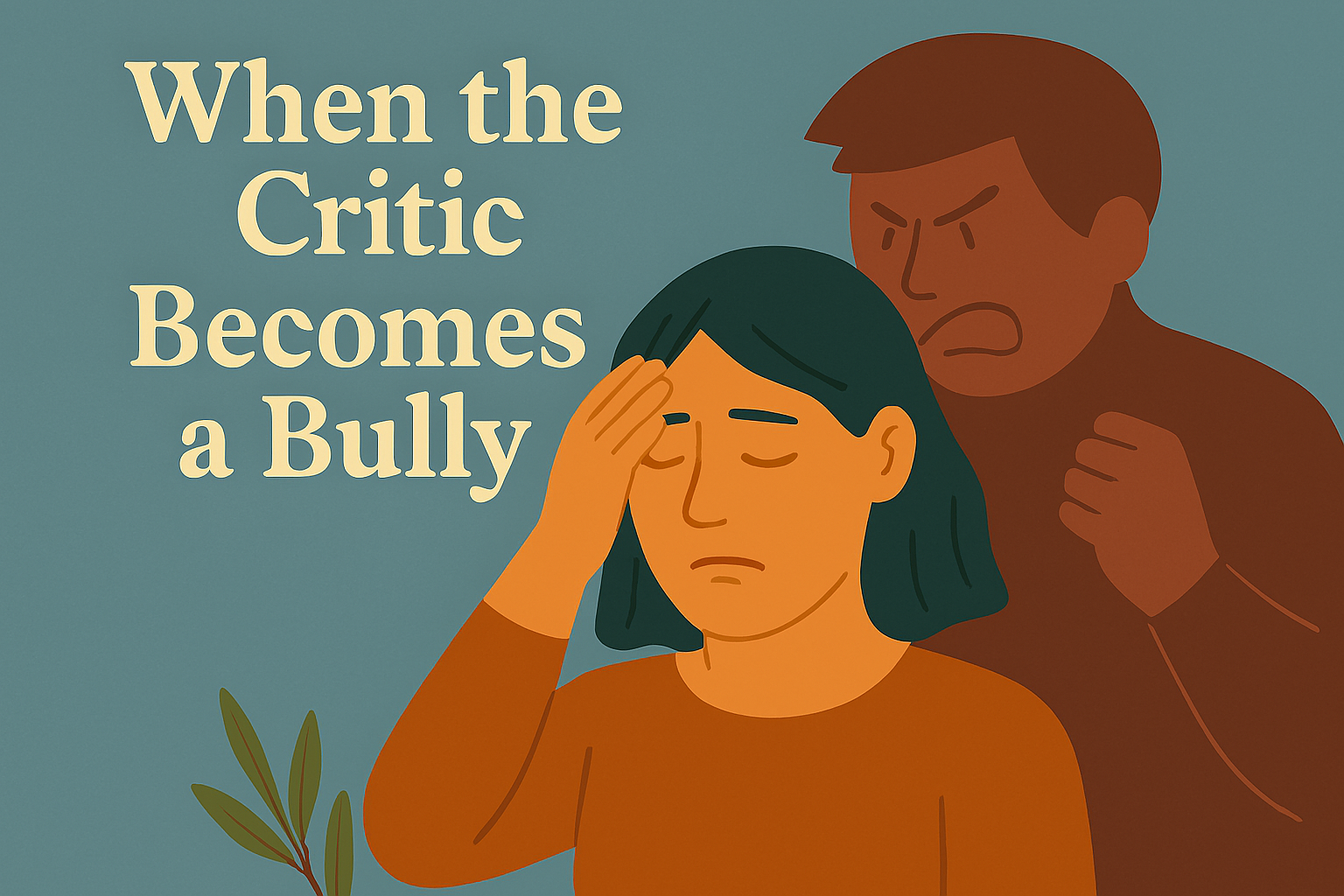
Here’s the thing: when that inner critic gets too loud, it’s not just “annoying” — it’s actually stressful for your whole system. Research shows that when we bully ourselves, our nervous system reacts in ways that are surprisingly similar to how it responds when someone else bullies or criticizes us. The brain doesn’t make a big distinction between external threat and internal threat. Criticism is criticism. Attack is attack. Whether it’s coming from someone across the room or from the voice in your own head, your body still flips into that same threat response — tight chest, racing thoughts, cortisol spike, the whole package.
So if you’ve ever wondered why self‑criticism feels so exhausting or overwhelming, it’s because your nervous system is treating it like a real social danger. And of course it is — humans are wired to take social threat seriously. That’s why this isn’t about “just thinking positive” or “stopping the thoughts.” It’s about understanding what’s happening inside you with compassion, and learning how to turn the volume down instead of trying to rip the speaker out of the wall.
When the inner critic becomes relentless, it can take a toll on the body
Why You Can’t Just Make your Inner Critic Shut Up
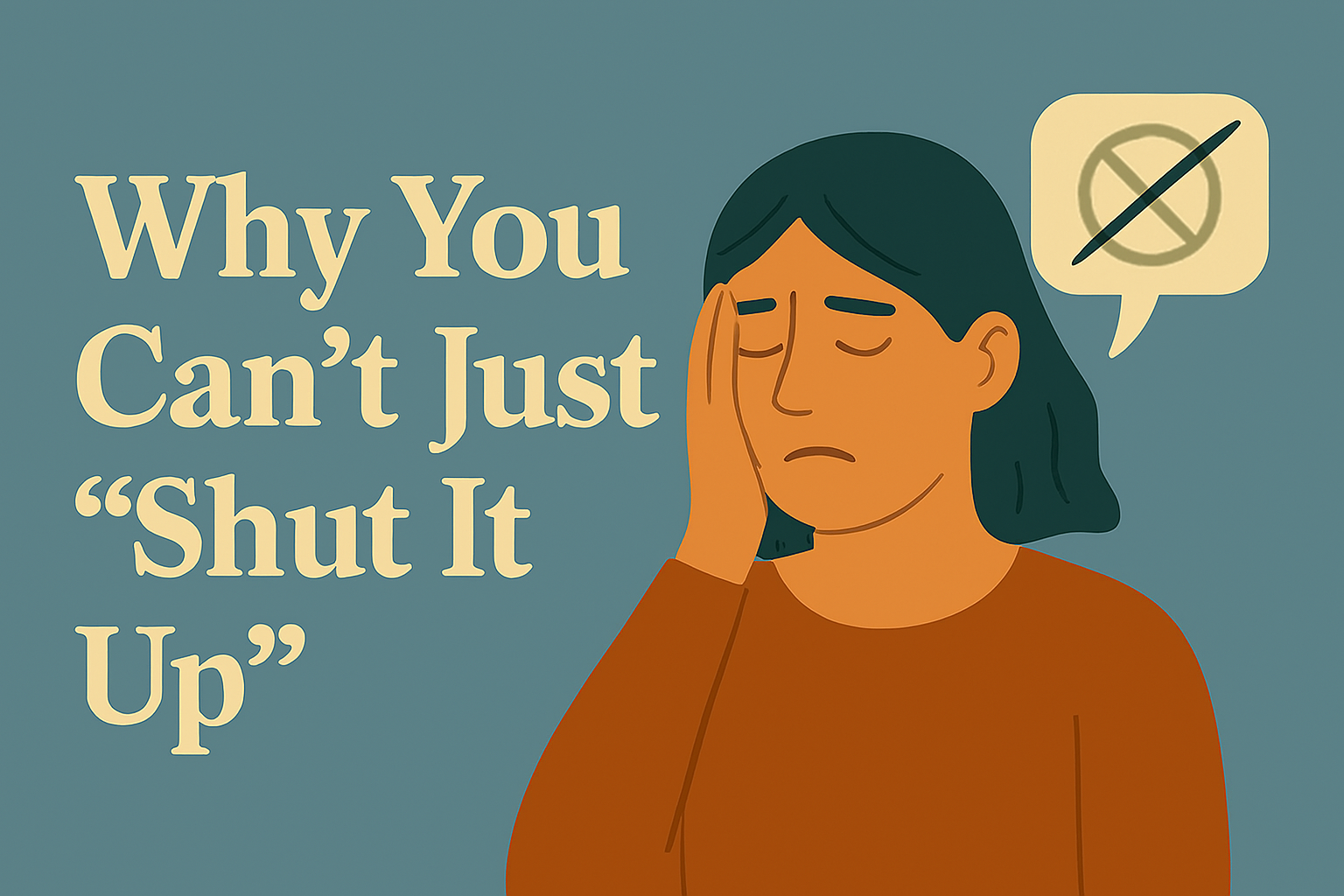
A lot of people try to silence the voice completely. It makes sense — when something feels harsh or overwhelming, our instinct is to shut it down, push it away, or pretend it isn’t there. But here’s the paradox: the more you try not to think something, the louder and more persistent it becomes. The brain doesn’t understand “don’t”; it only understands what you’re focusing on.
Try this little experiment: whatever you do, do not think of a green elephant. Don’t picture its colour, don’t imagine its shape, don’t let it wander into your mind at all.
What happened?
Exactly. The elephant shows up immediately, front and centre, waving its little green trunk like it owns the place.
This is the same thing that happens with your inner critic. When you try to banish it, suppress it, or slam the mental door in its face, it doesn’t disappear — it pounds harder. It gets louder. It becomes more frantic, because on some level it believes it’s protecting you, and being ignored feels dangerous. So instead of quieting down, it doubles down.
Trying to exile the inner critic doesn’t calm your system; it actually ramps it up. The real work isn’t about silencing the voice — it’s about changing your relationship with it so it no longer needs to shout.
We Actually Need That Voice — Just Not at Full Volume
The inner critic is part of your internal safety system. It didn’t show up because you’re broken or dramatic or overly sensitive — it developed because your brain is wired to keep you connected, loved, and socially safe. This inner critic often starts as a survival strategy for those who grew up in parentified roles. Humans survive in groups, so your nervous system is always scanning for anything that might put belonging at risk. The inner critic is one of the ways your brain tries to prevent that risk.
It watches for signs that you might be judged, rejected, or misunderstood. It replays conversations to make sure you didn’t accidentally offend someone. It warns you before you take a social risk. It tries to predict how others might react so you can stay in the “safe zone” of acceptance. In its own clumsy way, it’s trying to protect you from loneliness, conflict, embarrassment, or exclusion — all things the brain interprets as genuine threats.
This part of you learned its job when you were much younger, and it hasn’t updated its training manual since. It still thinks that being awkward in a conversation is a life‑or‑death situation. It still believes that if someone raises an eyebrow at you, your entire social world might collapse. It’s like having a smoke alarm that goes off not only for fires, but also for burnt toast, warm showers, and someone lighting a candle.
So yes — it’s trying to help. It’s just… not very skilled at its job. It’s overprotective. Overreactive. A little dramatic. It catastrophizes. It assumes the worst. It doesn’t know the difference between “mild discomfort” and “actual danger.”
And it didn’t develop in a vacuum. Early attachment experiences teach us what earns connection, approval, or safety, and many people internalize the voices or expectations of caregivers, teachers, or peers. Social learning reinforces this: we watch how others talk about mistakes, success, and worth, and we absorb those patterns. Cultural messaging adds another layer — productivity culture, gendered expectations, colonial narratives, and perfectionism all send powerful signals about what it means to be “good,” “successful,” or “acceptable.” Over time, these influences blend into an internal voice that tries to keep us aligned with what once felt necessary for belonging or protection.
The critic also gets louder during stress, burnout, or transitions. When the nervous system shifts into threat‑detection mode, the brain becomes more vigilant and less flexible. The critic ramps up in an attempt to regain control, prevent mistakes, or push you back toward familiar patterns. It’s not regression — it’s your system trying harder to keep you safe using strategies that once worked, even if they’re no longer helpful.
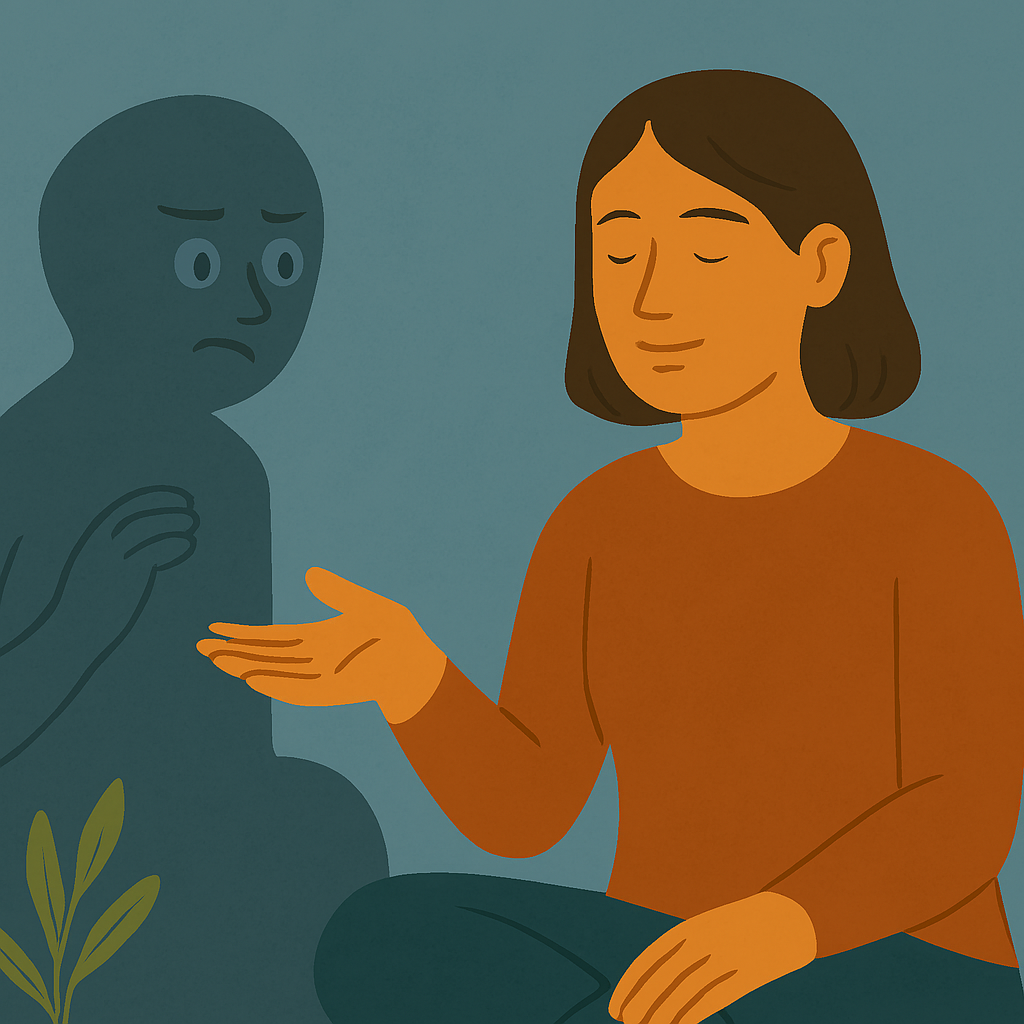
When you understand these things, the whole relationship shifts. Instead of seeing the inner critic as an enemy to fight, you can start to see it as a scared, overworked part of you that needs guidance, not exile. A part that’s trying to protect you, but needs you — the adult you — to step in and say, “Thank you, I’ve got this now.”
And for context: not everyone has a strong inner critic. Research on certain antisocial traits shows that people with significantly reduced guilt, shame, or concern about how others perceive them often have a much quieter or absent internal “don’t do that, people will judge you” voice. Those emotions — guilt, shame, social attunement — are the raw materials that build an inner critic in the rest of us. The volume of this voice varies for everyone. While some of us have a 'loud' inner critic, others naturally have a quieter internal radar. Both are part of the normal range of human diversity. In other words, the fact that you have an inner critic at all is a sign that your social‑emotional wiring is functioning exactly as it should. It’s just may be turned up a little too high.
So if you have an inner critic, congratulations — you’re human.
The Real Problem Isn’t Your Inner Critic — It’s the Volume
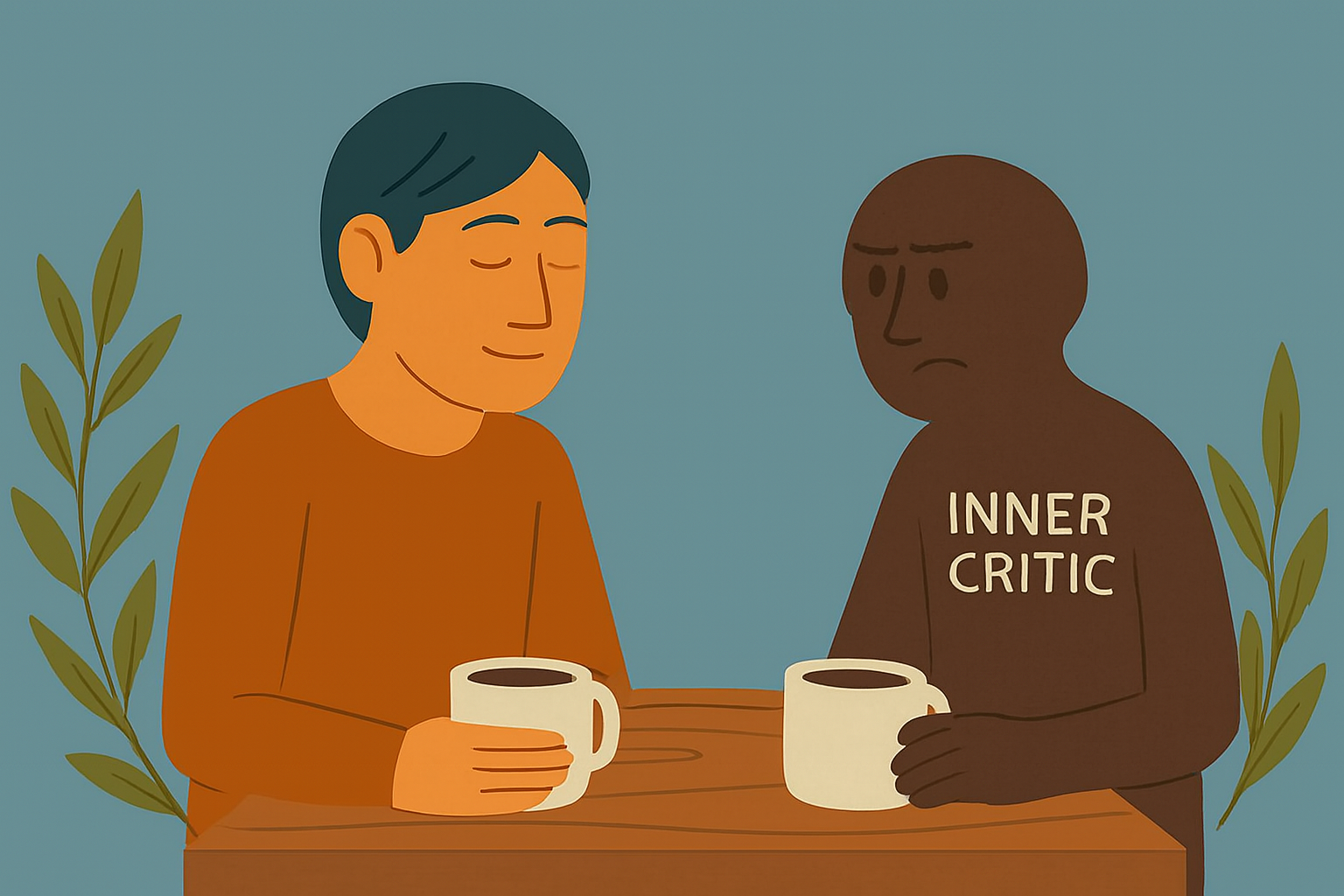
What if, instead of fighting that voice, you learned to work with it?
If the inner critic is part of your safety system — just an overzealous one — then the goal isn’t to fight it. Fighting often makes it louder. The aim is to shift the relationship so it doesn’t have to scream to get your attention.
The ideas below describe approaches therapists may discuss in clinical contexts. They are intended for general education and should not be interpreted as personalized treatment.
1. Acknowledge it instead of ignoring it
When the inner critic pipes up, many people find it helpful to gently acknowledge it with something like:
“I hear you. You’re worried I might embarrass myself or lose connection. I get why you’re here.”
This kind of acknowledgment, particularly under therapeutic guidance, can help settle the nervous system — even the parts that feel panicked or overwhelmed.
2. Name what it’s trying to do and thank it
Inner critics often try to:
- prevent rejection
- avoid conflict
- keep someone from repeating old hurts
- protect against shame
Some people find it grounding to say something like, “You’re trying to keep me safe,” as a way of shifting from fear to understanding. Expressing gratitude for its intentions can open the door to collaboration rather than conflict
3. Set boundaries with it — kindly
Many people talk to their inner critic the way they might speak to an anxious child or an overprotective friend:
“Thank you for trying to help, but I don’t need that level of alarm right now.”
“I’ve got this. You can rest.”
Firm but gentle. No yelling. No slammed doors.
4. Offer it a new job
The inner critic may not be great at predicting social disaster, but it can be surprisingly helpful at:
- noticing when rest is needed
- reminding you to prepare
- helping you reflect afterward
- nudging you toward your values
A common reframe is something like:
“Instead of warning me that I’m a disaster, can you help me remember what matters here?”
5. Bring in another internal voice
If the critic is the alarm system, people also have access to:
- a wise voice
- a compassionate voice
- a grounded adult voice
- a curious voice
Letting those parts speak too can sound like:
“I hear the fear, and I also know I’m safe.”
“I can handle this.”
6. Notice what happens in the body
The inner critic isn’t just words — it’s sensations:
- tight chest
- hot face
- stomach drop
Some people notice that placing a hand on the chest or belly and offering a gentle phrase like “We’re okay” can help the body settle. The nervous system responds to tone, warmth, and presence — even when it comes from within.
7. Practice tiny moments of repair
This isn’t about transforming the inner critic overnight. But each moment of responding with kindness instead of panic can contribute to meaningful shifts over time. It teaches that part of you that you’re not in danger — you’re in relationship.
And relationships change through repetition, not force.
8. Experiment with grounding
When the critic starts shouting, the body often tenses up. Before you "talk back," try a Long Exhale. By slowing your breath, you may signal to your nervous system that there is no physical predator in the room. This can make it much easier for your "Wise Advisor" voice to come online.
These do not replace individualized assessment and intervention. If you find your inner critic difficult to contend with, it is important to reach out for appropriate mental health support.
Imagine your inner critic as a part of you with its own goals — goals that ultimately are meant to benefit you. It just needs guidance, boundaries, and a calmer role in your internal system.
Are you a therapist, too? Even therapists have inner critics and sometimes need support!
A New Way Forward
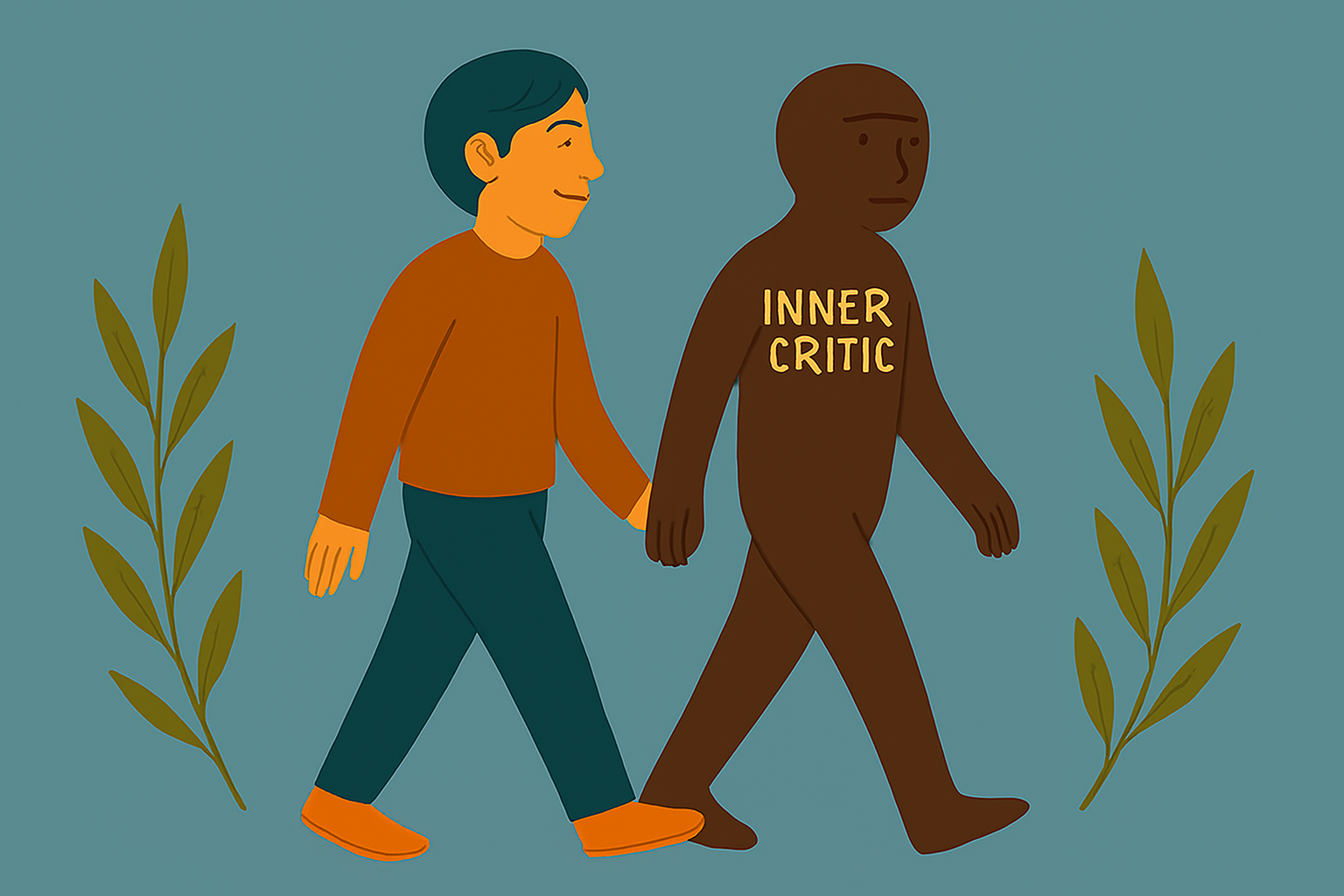
You don’t need to exile your inner critic. You don’t need to wrestle it into silence or pretend it isn’t there. You can simply renegotiate its job description.
Let it shift from drill sergeant to gentle advisor.
Let it warn you when something truly matters, not when you’re simply being human.
Some people find it helpful to think of the inner critic as a protective part that can be engaged differently. Let it become a partner instead of a tyrant — a voice that supports your growth instead of shrinking your world.
Because the goal isn’t to silence the voice.
The goal is to help it speak in a way that honours your life, your relationships, and your nervous system — a way that leaves room for compassion, curiosity, and connection.
And if this feels like a big shift to explore, many people find it helpful to do this work with support. If this topic resonates and you’re considering exploring it in therapy, you may find it useful to discuss these themes with a registered professional in a safe, confidential setting. Many clients report that working with a therapist on these themes helps them notice inner patterns more compassionately.
If you’d like a gentle reminder of how to notice your inner critic and call it in with compassion, we’ve put together a simple, one‑page guide of gentle experiments that many people find grounding. You’re welcome to download it and keep it close as you explore new ways of relating to that voice.

When to Seek Support
If you’re finding your inner critic especially overwhelming or difficult to navigate, reaching out for support can make a meaningful difference. A mental‑health professional can help you explore these patterns with care and clarity. If you connect with our team at Vistas, we can help you determine whether we’re a good fit, and if not, we’re always happy to offer referrals to help you find the right match for your needs. Learn more about our approach at Vistas to working with anxiety here.
This post offers general information for educational purposes. It is not therapy, does not replace individualized mental‑health care, and does not establish a therapeutic relationship. If you’re experiencing distress or need support, please connect with a qualified mental‑health professional in your area. If you are in immediate distress or at risk of harm, in Canada you can call or text 9‑8‑8 (Suicide Crisis Helpline) or call 9‑1‑1, and internationally you can visit FindAHelpline.com to locate free, confidential support services available in your specific country and language.
Amanda Carver, M.Ed, RP, is a Registered Psychotherapist and Director of Vistas Psychotherapy & Wellness and registered yoga teacher, providing integrative, neurobiology-informed care to clients in Ottawa, Toronto, and across Ontario via virtual practice.
Want to Know More?
If this topic is resonating and you want to keep exploring how to soften your inner critic, here are some thoughtful, research‑aligned resources that expand on these ideas with clarity and compassion.
📘 Book Recommendation
How to Be Yourself — Dr. Ellen Hendriksen
A warm, research‑based guide to understanding social anxiety and quieting the inner critic that fuels it.
🔗 https://www.ellenhendriksen.com/how-to-be-yourself (ellenhendriksen.com in Bing)
🎧 Podcast Episodes Worth Your Time
1. The Science of Happiness — “Quieting Your Inner Critic”
A gentle, practical look at why the inner critic exists and how to work with it.
🔗 https://greatergood.berkeley.edu/podcasts/series/the_science_of_happiness (greatergood.berkeley.edu in Bing)
(This link goes to the full podcast series; the “Quieting Your Inner Critic” episode is in their archive.)
2. Ten Percent Happier — Kristin Neff on Self‑Compassion
Kristin Neff explores how self‑compassion regulates the threat system and softens self‑judgment.
🔗 https://www.tenpercent.com/podcast/kristin-neff (tenpercent.com in Bing)
3. Unlocking Us with Brené Brown — “The Power of Self‑Compassion”
A grounded, relatable conversation about shame, belonging, and the inner critic.
🔗 https://brenebrown.com/podcast/introducing-unlocking-us/ (brenebrown.com in Bing)
(This is the main podcast page; the self‑compassion episode is in the archive.)
4. The Happiness Lab — “Treat Yourself Like a Friend”
Dr. Laurie Santos breaks down why our brains default to criticism and how to shift toward something more supportive.
🔗 https://www.happinesslab.fm/
5. Being Well with Dr. Rick Hanson — “Healing the Inner Critic”
A neuroscience‑informed, deeply human discussion about how early experiences shape the inner critic and how to cultivate a more compassionate internal voice.
🔗 https://www.rickhanson.net/being-well-podcast/ (rickhanson.net in Bing)
Frequently Asked Questions
What is the inner critic?
The inner critic is a pattern of self-talk that can be harsh or judgmental. It is often shaped by past experiences and may function as a protective response.
How do I stop negative self-talk?
Reducing negative self-talk often involves increasing awareness of thought patterns and exploring them in a supportive context, such as therapy.
Why is my inner critic so loud?
For many people, the inner critic becomes louder during stress, uncertainty, or when past experiences are activated.
Can therapy help with the inner critic?
Yes, therapy can help individuals understand the origins of self-critical thoughts and develop a more supportive internal dialogue.
📚 References & Further Reading
Psychopathy, Shame, and the Inner Critic
Djeriouat, H., & Trémolière, B. (2017). Shame and Guilt Situational Identification in Subclinical Primary Psychopaths. Current Psychology.
https://www.researchgate.net/profile/Hakim-Djeriouat-2/publication/321781335_Shame_and_Guilt_Situational_Identification_in_Subclinical_Primary_Psychopaths/links/5be01a0c92851c6b27a7b829/Shame-and-Guilt-Situational-Identification-in-Subclinical-Primary-Psychopaths.pdf
Kyranides, M. N., Rennie, M., & McPake, L. (2024). Primary and Secondary Psychopathic Traits: Investigating the Role of Attachment and Experiences of Shame. The Journal of Psychology.
https://www.tandfonline.com/doi/pdf/10.1080/00223980.2023.2211322
Singh, D., & Bhushan, B. (2025). Understanding shame, guilt, embarrassment and pride: a systematic review of self-conscious emotions. Frontiers in Psychology.
https://www.frontiersin.org/journals/psychology/articles/10.3389/fpsyg.2025.1678930/full
Spice, A., Viljoen, J. L., Douglas, K. S., & Hart, S. D. (2015). Remorse, Psychopathology, and Psychopathy Among Adolescent Offenders. Law and Human Behavior.
Summary: https://paloaltou.edu/resources/translating-research-into-practice-blog/shame-and-guilt-are-important-to-the-understanding-of-psychopathy-and-psychopathology-in-juveniles/
Djeriouat, H., & Trémolière, B. (2020). Shame and Guilt Situational Identification in Subclinical Primary Psychopaths. Current Psychology, 39, 238–245.
https://link.springer.com/article/10.1007/s12144-017-9756-8
How Self‑Bullying Activates the Threat System
The Physiology of Self‑Criticism.
Overview of how harsh self‑criticism activates the brain’s threat system (amygdala activation, sympathetic arousal), mirroring responses to external social threat.
Source: Self‑Compassion Skills / MI‑Psych.
https://mi-psych.com.au/the-physiology-of-self-criticism/ (mi-psych.com.au in Bing)
Kim, J. J., Kent, K. M., Cunnington, R., Gilbert, P., & Kirby, J. N. (2020).
Attachment styles modulate neural markers of threat and imagery when engaging in self‑criticism. Scientific Reports.
https://www.nature.com/articles/s41598-020-69232-9 (nature.com in Bing)
Zaccari, V., Mancini, F., & Rogier, G. (2024).
State of the art of the literature on definitions of self‑criticism: a meta‑review. Frontiers in Psychiatry.
https://www.frontiersin.org/articles/10.3389/fpsyt.2024.1339174/full (frontiersin.org in Bing)
Šoková, B., Greškovičová, K., Halamová, J., & Baránková, M. (2024).
Breaking the vicious cycles of self‑criticism: a qualitative study on the best practices of overcoming one’s inner critic. BMC Psychology.
https://bmcpsychology.biomedcentral.com/articles/10.1186/s40359-024-01845-1 (bmcpsychology.biomedcentral.com in Bing)
Cwinn, E. (2018).
Self‑Criticism and Responses to Self‑Critical Statements. Doctoral thesis, University of Guelph.
https://atrium.lib.uoguelph.ca/items/1e7b4e4a-7e4d-4e3c-9c3c-2e9e3b8f1c9f (atrium.lib.uoguelph.ca in Bing)
Talking Back to the Inner Critic
Wakelin, K. E., Perman, G., & Simonds, L. M. (2021).
Effectiveness of self‑compassion‑related interventions for reducing self‑criticism: A systematic review and meta‑analysis. Clinical Psychology & Psychotherapy.
https://onlinelibrary.wiley.com/doi/full/10.1002/cpp.2605 (onlinelibrary.wiley.com in Bing)
Brown, N., & Ashcroft, K. (2025).
The Effectiveness of Compassion Focused Therapy for the Three Flows of Compassion, Self‑Criticism, and Shame in Clinical Populations: A Systematic Review. Behavioral Sciences.
https://www.mdpi.com/2076-328X/15/1/12 (mdpi.com in Bing)
Šoková, B., Greškovičová, K., Halamová, J., & Baránková, M. (2025).
(Also listed above) A qualitative study identifying effective strategies for interrupting self‑critical cycles and cultivating alternative internal responses.
https://bmcpsychology.biomedcentral.com/articles/10.1186/s40359-024-01845-1 (bmcpsychology.biomedcentral.com in Bing)
Psychopathy, Shame, and the Inner Critic
Djeriouat, H., & Trémolière, B. (2017). Shame and Guilt Situational Identification in Subclinical Primary Psychopaths. Current Psychology.
https://www.researchgate.net/profile/Hakim-Djeriouat-2/publication/321781335_Shame_and_Guilt_Situational_Identification_in_Subclinical_Primary_Psychopaths/links/5be01a0c92851c6b27a7b829/Shame-and-Guilt-Situational-Identification-in-Subclinical-Primary-Psychopaths.pdf
Kyranides, M. N., Rennie, M., & McPake, L. (2024). Primary and Secondary Psychopathic Traits: Investigating the Role of Attachment and Experiences of Shame. The Journal of Psychology.
https://www.tandfonline.com/doi/pdf/10.1080/00223980.2023.2211322
Singh, D., & Bhushan, B. (2025). Understanding shame, guilt, embarrassment and pride: a systematic review of self-conscious emotions. Frontiers in Psychology.
https://www.frontiersin.org/journals/psychology/articles/10.3389/fpsyg.2025.1678930/full
Spice, A., Viljoen, J. L., Douglas, K. S., & Hart, S. D. (2015). Remorse, Psychopathology, and Psychopathy Among Adolescent Offenders. Law and Human Behavior.
Summary: https://paloaltou.edu/resources/translating-research-into-practice-blog/shame-and-guilt-are-important-to-the-understanding-of-psychopathy-and-psychopathology-in-juveniles/
Djeriouat, H., & Trémolière, B. (2020). Shame and Guilt Situational Identification in Subclinical Primary Psychopaths. Current Psychology, 39, 238–245.
https://link.springer.com/article/10.1007/s12144-017-9756-8
How Self‑Bullying Activates the Threat System
The Physiology of Self‑Criticism.
Overview of how harsh self‑criticism activates the brain’s threat system (amygdala activation, sympathetic arousal), mirroring responses to external social threat.
Source: Self‑Compassion Skills / MI‑Psych.
Kim, J. J., Kent, K. M., Cunnington, R., Gilbert, P., & Kirby, J. N. (2020).
Attachment styles modulate neural markers of threat and imagery when engaging in self‑criticism.
This fMRI study shows that self‑criticism activates neural threat markers similar to those triggered by external criticism.
Source: Scientific Reports.
Zaccari, V., Mancini, F., & Rogier, G. (2024).
State of the art of the literature on definitions of self‑criticism: a meta‑review.
A comprehensive review showing that self‑criticism functions as a self‑directed threat response.
Source: Frontiers in Psychiatry.
Šoková, B., Greškovičová, K., Halamová, J., & Baránková, M. (2024).
Breaking the vicious cycles of self‑criticism: a qualitative study on the best practices of overcoming one’s inner critic.
Highlights the distress and threat‑based cycles created by self‑critical inner dialogue.
Source: BMC Psychology.
Cwinn, E. (2018).
Self‑Criticism and Responses to Self‑Critical Statements.
Doctoral thesis exploring self‑criticism as a form of internal attack that triggers defensive physiological responses.
Source: University of Guelph.
Loneliness as a Public Health Concern
The Impact of Loneliness on Health and Lifespan.
Overview of how chronic loneliness increases risk for depression, cardiovascular disease, cognitive decline, and premature death—comparable to smoking or obesity.
Source: World Health Organization / Commission on Social Connection.
https://www.who.int/news/item/01-11-2023-who-launches-commission-on-social-connection (who.int in Bing) (who.int in Bing)
World Health Organization. (2023).
WHO launches Commission on Social Connection to address loneliness as a pressing health threat.
https://www.who.int/news/item/01-11-2023-who-launches-commission-on-social-connection (who.int in Bing) (who.int in Bing)
The Paradox of Thought Suppression
Why Trying Not to Think About Something Backfires.
Overview of how deliberate thought suppression triggers a rebound effect, making the unwanted thought more frequent, more intrusive, and harder to control — the classic “white bear” phenomenon.
Source: Wegner et al., Journal of Personality and Social Psychology.
Wegner, D. M., Schneider, D. J., Carter, S. R., & White, T. L. (1987).
Paradoxical effects of thought suppression. Journal of Personality and Social Psychology, 53(1), 5–13.
https://psycnet.apa.org/record/1987-34571-001 (psycnet.apa.org in Bing) (apa.org in Bing)
Ironic Process Theory
Why Mental Control Efforts Can Backfire.
Overview of how attempts to suppress unwanted thoughts activate two competing cognitive processes — one intentional and one automatic — leading to increased intrusiveness of the very thought we’re trying to avoid.
Source: Wegner, Psychological Review.
Wegner, D. M. (1994).
Ironic processes of mental control. Psychological Review, 101(1), 34–52.
https://doi.org/10.1037/0033-295X.101.1.34 (doi.org in Bing) (doi.org in Bing)
Mindfulness and Thought Suppression
How Mindfulness Reduces the Rebound Effect.
Overview of how mindfulness practices—especially open monitoring and non‑judgmental awareness—reduce the paradoxical rebound of unwanted thoughts by shifting from suppression to acceptance, decreasing cognitive load and intrusive thought frequency.
Source: Farb et al., Social Cognitive and Affective Neuroscience.
Farb, N. A., Anderson, A. K., & Segal, Z. V. (2012).
The mindful brain and emotion regulation in mood disorders. Social Cognitive and Affective Neuroscience, 7(1), 1–17.
https://doi.org/10.1093/scan/nsr044 (doi.org in Bing) (doi.org in Bing)