

Therapist Imposter Syndrome: How to Quiet Your Inner Critic in Clinical Work

If you’re a new therapist, you’ve probably met the voice that says you’re not doing enough. It’s loud, persistent, and convinced you’re failing. You’re not. You’re just entering the gray.
And you’re not alone. These are some of the most common fears that show up in supervision — not because therapists are incompetent, but because the structure of our profession creates the perfect conditions for self‑doubt.
And here’s the truth we rarely say out loud:
Many therapists find their inner critics intensify because the structure of training and early practice creates conditions where self‑doubt naturally emerges.
Let’s unpack why.
What Is Imposter Syndrome in Therapists?
Imposter syndrome shows up differently in therapists than it does in most professions. It isn’t just the fear of “not being good enough” — it’s the quiet, persistent worry that you’re missing something important, that you’re not being “clinical” enough, or that everyone else seems to know what they’re doing while you’re still fumbling in the gray.
For many new clinicians, this inner tension doesn’t come from incompetence. It comes from stepping into a field where the work is intimate, ambiguous, relational, and largely invisible. You’re asked to make sense of human complexity using tools that were often taught in neat, linear models. You’re expected to hold space for uncertainty while your own nervous system is still learning how to tolerate it. And you’re doing all of this behind a closed door, without real‑time feedback, in a profession where progress unfolds slowly and quietly.
So when that inner voice whispers, “You’re not doing enough,” it’s not a sign that you’re failing. It’s a sign that you’re human — and that you care deeply about doing right by the people who sit across from you.
Imposter syndrome in therapists isn’t a flaw. It’s a developmental experience. And when we understand what it’s trying to protect, we can work with it instead of being ruled by it.
Why Imposter Syndrome Is So Common in Therapists
Therapists are uniquely vulnerable to imposter syndrome because of a perfect storm of factors.
1. The Theory–Practice Gap That Fuels Therapist Imposter Syndrome
The Theory-Practice Gap
Many therapists in Ontario are trained on "coast-to-coast" curricula—generalized models designed for a broad, often Americanized market. These programs lean heavily on the Medical Model: a clean, linear sequence where a "patient" presents a "symptom," the "expert" applies a "manualized intervention," and "resolution" is reached in ten sessions.
This structure offers a false sense of security. It promises that if you just follow the steps of a specific modality, the "gray" will resolve into a clear "white."
The Regulatory Collision
Then, you meet the College of Registered Psychotherapists of Ontario (CRPO). Suddenly, the abstract theory hits the wall of provincial reality. You realize that "structured modalities" don't always account for:
- The CRPO’s Scope of Practice: Which highlights the centrality of the therapeutic relationship, rather than just the "tool" you’re using.
- The Community Landscape: In Ontario’s community-based therapy world—where waitlists are long and systemic issues like housing or precarious employment are rampant—the "10-session arc" feels like a fantasy.
The "Messy Life" Mismatch
The real heartbreak for a new therapist happens in the 20th minute of the first session. You’re looking for the "issue" so you can build the "treatment plan," but the client is giving you life: a tangled web of relational trauma, financial stress, and contradictory emotions that don't fit into a checkbox.
When the client doesn't follow the "intervention → resolution" script, the new therapist doesn't usually blame the curriculum. They blame themselves. That mismatch creates a profound sense of self-doubt—the "Imposter Syndrome" of the gray. It's common for new therapists to feel like they're failing because they can’t make the client’s life linear, when in reality, the "failure" is the curriculum’s inability to acknowledge that human life is inherently non-linear.
The Developmental Reframe
Living in the gray means accepting that you aren't a mechanic fixing a machine; you are an observer and a participant in a complex ecosystem. The self-doubt you feel isn't a sign of incompetence—it's the birth pains of a truly relational therapist.
2. CRPO’s Definition of Psychotherapy is Specific
The Regulatory Definition: A High Bar
The College of Registered Psychotherapists of Ontario (CRPO) doesn't just describe therapy; it defines a Controlled Act. To perform it, five specific elements must exist simultaneously:
1. Treating... 2. by means of psychotherapy technique... 3. delivered through a therapeutic relationship... 4. an individual’s serious disorder of thought, cognition, mood, emotional regulation, perception, or memory... 5. that may seriously impair the individual’s judgment, insight, behaviour, communication, or social functioning
This is a simplified summary for educational purposes — therapists should always refer directly to CRPO’s official documents for full definitions.
The Reality of "Counselling" vs. "Psychotherapy"
The CRPO itself acknowledges that not everything we do is the "Controlled Act." They distinguish between high-risk "Psychotherapy" and "Counselling/Support," which includes:
- Assisting in resolution of dilemmas.
- Improving coping strategies.
- Advice-giving or instruction.
Reclaiming the Definition
Here is the nuance that fuels the inner critic: the CRPO notes that Psychotherapy and counselling can be highly interrelated and the distinction between them is not always clear.
The developmental task isn't to force every session into the "Controlled Act" box. It’s to recognize that the therapeutic relationship is the foundation that allows the controlled act to happen at all. The Controlled Act is the clinical peak of our work, but the foundation of counselling and the therapeutic relationship is what makes that act safe and effective. You are holding the space so that when the "serious impairment" does show up, the relationship is strong enough to handle it.
Your value isn't found in how perfectly you execute a 'controlled act'; it's found in your ability to navigate the space where the legal definition and the human experience meet.
If interpreted too narrowly, the Controlled Act definition can feel disconnected from the day‑to‑day reality of relational work — which is why many therapists experience uncertainty about where their work fits.
Which leads many therapists to quietly think:
“If this isn’t therapy… what am I doing?”
3. Supportive counselling is undervalued — even though it’s the backbone of the work
This is where CRPO’s definitions can feel confusing or intimidating when you’re new to the field. CRPO distinguishes between the Controlled Act of Psychotherapy and counselling/support activities such as encouragement, advice‑giving, and assisting in the resolution of dilemmas.
For a new therapist, this creates a devastating internal split. Your inner critic looks at the CRPO’s list and starts to "thin out" your clinical worth. It whispers:
- “If you’re just helping them navigate a conflict with their mother, you’re just 'counselling.'”
- “If you’re offering coping strategies for a job interview, you aren't treating a 'serious disorder.'”
The result? We start to treat Supportive Counselling—the very thing most clients are actually starving for—as a secondary, lesser skill. We feel like we’re "failing" if we aren't performing surgical-level psychotherapy in every 50-minute hour.
It’s important to note that when the elements of the controlled act are met, therapists must ensure they are authorized and practicing within CRPO standards.
The Reality of the Room
But step away from the regulatory definitions and the textbook arcs, and you find a different truth: Clients don't come in asking for a controlled act; they come in asking you to hold space for them.
In the messiness of community-based therapy, the "gray" is where most of the life happens. Real healing often looks like:
- Validating a client’s rage at a systemic injustice.
- Helping someone find the language to set a tiny boundary at work.
- Simply sitting as a stable, regulated presence for someone who has never had one.
But supportive counselling — the thing most clients actually need — is rarely celebrated.
The imposter syndrome thrives on the idea that these moments are "filler" until the "real therapy" (the acronyms) can begin. But the narrative needs to shift.
Being an RP in Ontario involves moving fluidly between supportive counselling and psychotherapy, depending on the client’s needs and the clinical context. It means you have the clinical sophistication to know when to move between the supportive foundation of counselling and the targeted intervention of psychotherapy.
The supportive work is often the foundation of therapy — the relational soil in which any deeper work can take root. When we celebrate the gray, we stop being "technicians" and start being therapists.
4. We don’t get real‑time feedback or direct observation
In most professions, you work under the gaze of a mentor or the safety net of a team, but the therapist enters a uniquely isolated arena. Once the door closes, you are essentially working in a vacuum. No one is there to observe your nuanced interventions or to catch the moments where you fumbled a reflection. Because clients rarely offer moment-to-moment feedback—and because "success" in mental health is a slow, invisible burn rather than a sudden breakthrough—you are left to evaluate your own efficacy based on nothing but your internal barometer.
We exacerbate this isolation by benchmarking our messy, private reality against the polished, public highlight reels of other therapists on social media. We compare our "behind-the-scenes" to the idealized case examples in textbooks and trainings, where the technique being sold works with a breezy, effortless precision that rarely survives the first five minutes of a real session. While evidence-based models are essential, therapists often need to adapt them to the complexity of real-world practice.
This professional solitude is the primary breeding ground for the inner critic. Without immediate markers of progress or a peer to validate the "invisible" work of holding space, the silence of the room becomes a canvas for self-doubt. When a session feels heavy or stalled, the critic doesn't blame the complexity of the human experience; it blames you. In that vacuum, you begin to mistake the client’s quiet processing for your own clinical failure, leading to an imposter syndrome that thrives simply because there is no one else in the room to tell you that you’re doing just fine.

5. Therapy takes time — and slow change feels like failure
In most professions, you can point to a finished product at the end of the day—a cleared inbox, a repaired engine, a line of code that finally runs. Therapy offers no such instant gratification. Progress in the room is notoriously subtle, moving in loops and spirals rather than a straight line. Change often happens beneath the surface, like the slow shifting of tectonic plates, while the surface remains deceptively still. Because we lack the immediate dopamine hit of "fixed" problems, it becomes dangerously easy for the inner critic to fill that void with a narrative of failure. We start to believe that if the client is repeating a pattern or if the session feels heavy, then "nothing is happening," "I’m not helping," or worse, "someone else could do this better."
However, we must remind ourselves that the therapeutic equivalent of a "crash diet"—the quick fix or the flashy, immediate breakthrough—is rarely what leads to lasting transformation. Real, sustainable change is a slow-motion integration of new perspectives and skills that requires the steady, patient presence of a therapist who doesn't panic in the quiet. Our job isn't to force a result, but to provide the consistent environment where these incremental shifts can take root. We are playing the long game; slow change isn't just "better than nothing," it is often the only change that has the structural integrity to stick for the long term.
6. The work is shades of grey
Moving from the black-and-white world of textbooks to the "technicolor gray" of a therapy room is less of a professional transition and more of an existential ego-bruising. For a new therapist, sitting in the gray isn't just a clinical skill; it’s an endurance sport.
Therapy is inherently ambiguous:
- competing truths - In the gray, two opposing things are often true at once. A client can desperately want to leave a toxic partner and simultaneously be deeply in love with them. As therapists, we often feel compelled to pick a side, when we need to do the work alongside them of trying to hold both truths and not find the perfect answer
- Non-linear growth - change takes a meandering route. We will often confuse a twist in the clients path for signs that we have failed.
- ethical nuance - Graduate school teaches ethics in terms of "do" and "don't." The real world operates in the "it depends." Shifting away from looking for a right answer an instead leaning in to the practice of finding "The Most Responsible Choice" takes time
The hardest task is realizing that a therapist’s discomfort can offer valuable information about the emotional landscape of the room. When you feel the tension of the gray, you are likely feeling exactly what the client feels—the paralyzing weight of a life that doesn't have a clean answer.
If you can stay grounded in that space, you model that complexity can be tolerated. You give the client permission to exist in their own mess without shame.
"The gray isn't a place where you're lost; it's the space where the most authentic work happens because it's the only place that's actually real."
Most of us spend hours coaching clients on accepting that the world is only shades of grey, while we struggle with grey in the therapy room.
Signs of Imposter Syndrome in Therapists
Imposter syndrome in therapists doesn’t usually announce itself with dramatic self‑doubt. It shows up in subtle, private moments — the quiet places where your nervous system is still learning how to tolerate the weight of the work. Here are some of the most common ways it tends to surface in early practice:
1. Feeling like you “didn’t do enough” after a session
You leave the room convinced you were too supportive, too conversational, too “non‑clinical,” even though the client left calmer, clearer, or more connected than when they arrived.
2. Comparing yourself to an imagined standard of the “real therapist”
You picture other clinicians delivering flawless interventions, navigating every rupture with ease, or somehow knowing exactly what to say. Meanwhile, you’re in the room making your best guess in real time.
3. Interpreting uncertainty as incompetence
Instead of seeing ambiguity as part of the work, you read it as a personal failing — as if not having the perfect formulation on the spot means you’re unprepared or unskilled.
4. Feeling anxious about being “found out” by supervisors or the College
A completely normal developmental fear: that someone will look at your notes, your interventions, or your pacing and decide you’re not doing therapy “properly.”
5. Over‑relying on manuals or protocols to feel safe
You cling to structure not because the client needs it, but because you need reassurance that you’re doing something measurable, defensible, or “correct.”
6. Minimizing the relational work because it feels too simple
You discount the attunement, presence, and steady pacing you offer — even though these are often the very things clients experience as healing.
7. Feeling responsible for client outcomes
You subtly take on the belief that if a client isn’t progressing quickly, it must be because you’re missing something, not because change is slow, nonlinear, and deeply human.
8. Feeling like every session should be a breakthrough
You worry that if the hour wasn’t transformative, then you weren’t effective — forgetting that most therapeutic change happens quietly, cumulatively, and beneath the surface.
What the Therapist’s Inner Critic Is Actually Trying to Do
Just like the clients we serve, we have to recognize that our inner critic isn't a villain—it is a protector with a very poor communication style. When you hear that internal voice whispering, "You’re not doing enough," "You should have mastered this modality by now," or the paralyzing, "What if I’m not meeting the College’s expectations?" it isn't actually trying to shame you. It is operating on a primitive survival instinct. It perceives the inherent ambiguity of therapy as a threat, and it uses criticism as a preemptive strike to keep you hyper-vigilant and, theoretically, "safe" from professional failure or external judgment.
This critic is particularly loud for new therapists because it thrives in the absence of clarity. When the "system"—whether that's navigating provincial regulations, a messy community-based caseload, or a nonlinear client arc—fails to provide a clear map, the critic steps in to fill the gaps with its own rigid rules. It mistakes your clinical uncertainty for a sign that something is wrong, so it tries to "protect" you by demanding an impossible standard of perfection. Understanding this shift is vital: your imposter syndrome isn't a sign of incompetence; it is a sign of a protective system that hasn't yet learned to trust the "gray."
It is a persistent, exhausting pain in the ass to live with this level of self-scrutiny, but there is a hidden utility in the noise. At its core, the inner critic often amplifies the part of you that cares deeply about responsibility and ethical practice. It screams because it cares deeply about the weight of the responsibility you carry. It is the part of you that refuses to become complacent or indifferent to the human lives entrusted to your care.
For many therapists, the goal isn't to silence this voice entirely—which is likely impossible anyway—but to learn how to translate its panicked shouts into useful data. When we stop trying to push the critic away and instead learn to soften its jagged message, we transform it from a source of shame into a tool for refinement. By listening for the kernel of professional integrity hidden beneath the criticism, we move from being paralyzed by "not being enough" to being empowered to consciously develop. We start to use that tension to shape us, informing our continuing education and our clinical boundaries, ultimately allowing the critic’s protective energy to fuel our evolution into the most authentic, grounded versions of our therapist selves.
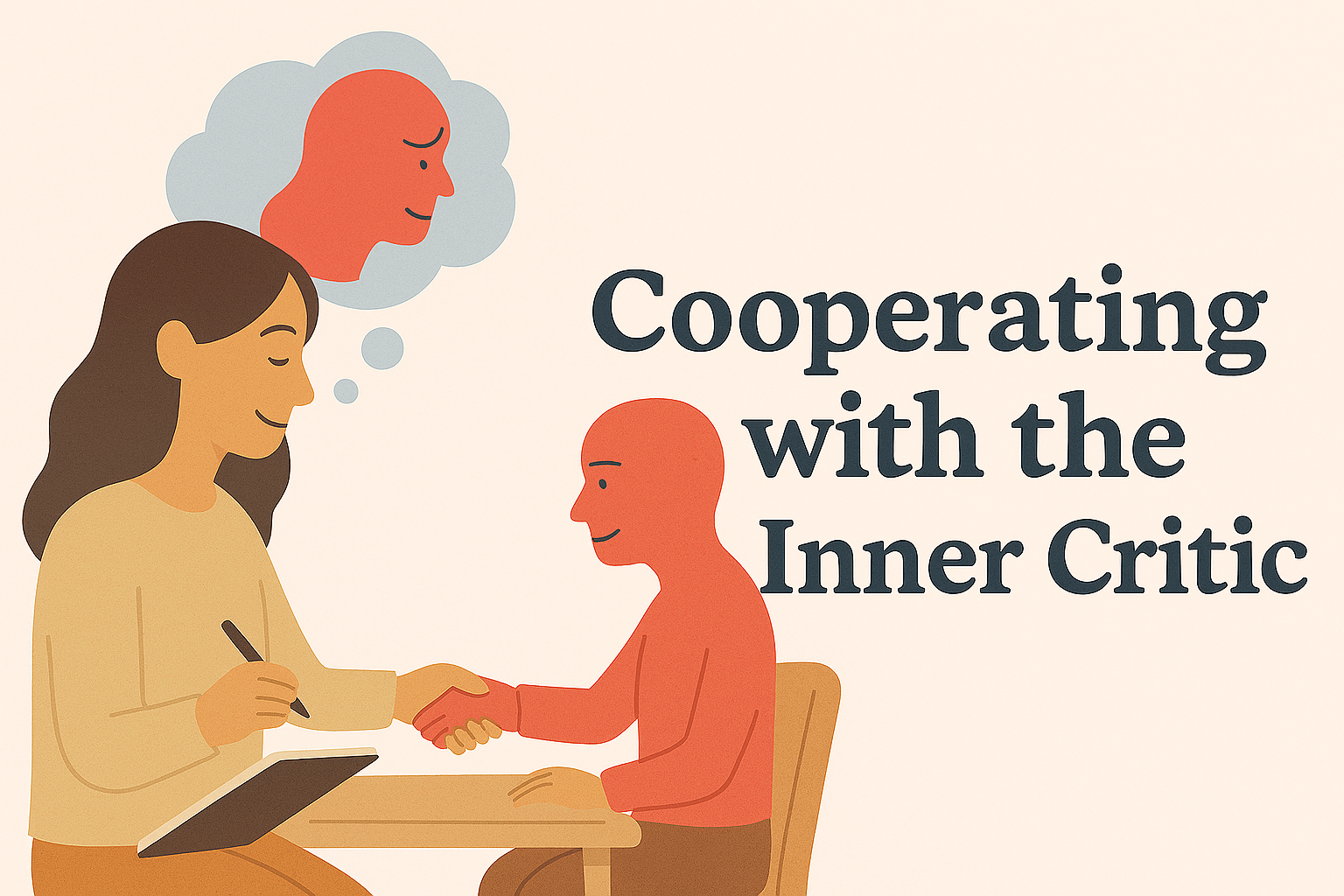
How to Work With the Therapist’s Inner Critic
1. Many therapists find it helpful to notice the physical state before getting pulled into the story
Your nervous system shifts first; the story follows. When you feel that spike of anxiety, your brain frantically writes a script: “I’m failing.” Recognize the physical sensation of the "protector" activating before you buy into the narrative it’s selling.
2. Reality-Check the Expectations
Gently remind yourself that the "10-session arc" with a neat, cinematic resolution reflects a structured teaching model rather than the complexity of real clinical work. Most clients need a consistent holding environment, not a rigid adherence to protocols that ignore their lived experience.
3. Returning to your foundational training in supportive counselling can help ground you when the inner critic insists that ‘nothing is happening'
Refer back to your regulatory and clinical foundations. When you can confidently name that you are providing attunement, validation, and containment, the inner critic loses its power to tell you that "nothing is happening."
4. Seek Supervision that Normalizes the Messiness
Quality supervision shouldn't feel like a performance review; it should feel like a relief. Seek out spaces that celebrate the "gray" and provide perspective rather than just corrective or a push towards "perfection."
5. It can be Grounding to Remember: You Hold the Map, Not the Wheel
This is the ultimate boundary. You are the navigator, not the driver.
- You guide.
- You accompany.
- You do not control outcomes.
Relieving yourself of the "driver" status immediately lowers the stakes for the inner critic.
6. Learn to Live in the Gray
Clinical ambiguity is a natural part of the work, and many therapists find that learning to tolerate it is a key developmental milestone. This is the primary developmental arc of becoming a seasoned clinician. Ironically, by learning to sit in the gray yourself, you are modeling the exact emotional flexibility we ask of our clients.
7. Reframe Protection as Conscientiousness
When the critic shouts "Be careful" or "Double-check your notes," recognize that it is the harshest version of your ethical compass. That isn't failure; it’s conscientiousness. Some therapists find it helpful to thank the critic for its vigilance, then dial the volume down to a level that informs your work without paralyzing it.
The goal isn't to be a perfect therapist; it's to be a present one. Going back to my attachment therapist roots, we only need "good enough" attachment. The inner critic wants perfection because it feels safe; the client wants presence because it's healing.
The Moments That Matter Aren’t in the Manuals
Every therapist knows this specific, quiet ache: you leave a session feeling like you merely "survived" the hour, thinking, “I didn’t do much today. I wasn't clinical enough.” Then, months later, that same client looks at you and says:
- “I’ll never forget when you said...”
- “That one moment changed everything for me.”
- “I truly couldn’t have done this without you.”
And here is the humbling truth: it is almost never the perfectly delivered, manualized intervention they remember. It’s rarely the CBT thought record or the structured EMDR protocol (both of which are therapies I lean into often!). While fidelity to evidence-based protocols is essential for specific outcomes, the protocol only works if it is delivered within a flexible, attuned relationship.
It is always the relational moment.
It’s the thing you said in passing that made them feel seen for the first time. It’s the unwavering attunement, the radical presence, and the steady pacing of a room that finally felt safe enough for them to exhale.
This is the heart of supportive counselling. It isn't a "placeholder" for therapy. While it isn't the Controlled Act, it is often a profoundly therapeutic act of human connection. When we stop measuring our worth by the acronyms we use and start valuing the safety we provide, we realize that the "simple" work was actually the most transformative work of all.
The inner critic screams when you deviate from the manual, but your intuition knows that the manual was never the destination. Trust the connection alongside the protocol; your clients don't need a perfect expert—they need a witness who can withstand the silence.
If you feel uncertain, ambivalent, or not enough — it’s not a sign you’re failing. It’s a sign you’re doing the real work.
If you’re craving steadier footing in the gray, consider bringing this into supervision — it’s where the real growth happens. If you want support in building confidence in the messy middle, reach out today for a free consult. This is the work I love helping clinicians develop. Read more about my philosophy of supervision here.
Need a few more self care tips? Read my blog post Self-Care Tips for Therapists You Actually Need!
Still need a bit more self care? Here is our tip sheet on Self-Care for the Critic-Weary Clinician
If you'd like to build on this in a live setting, our workshop The Art of the Question explores clinical questioning skills in a supportive group format.
This content is for general educational purposes and is written for therapists early in their careers. It is not therapy, clinical guidance, or professional supervision, and it does not establish a therapeutic, supervisory, or consultative relationship. If you’re experiencing distress, please reach out to a qualified mental‑health professional. If you are in immediate distress or at risk of harm, in Canada you can call or text 9‑8‑8 or call 9‑1‑1; internationally, visit FindAHelpline.com for free, confidential support in your region.
Written by a Registered Psychotherapist (RP) practicing in Ontario, with experience supporting early-career clinicians in supervision and consultation
FAQs About Imposter Syndrome in Therapists
Is imposter syndrome normal for new therapists?
Yes—imposter syndrome is extremely common among new therapists. Early clinical work involves high responsibility, limited feedback, and a steep transition from theory to real-world complexity. Many therapists report increased self-doubt during their first years of practice, especially as they begin working more independently.
Why do therapists experience imposter syndrome?
Therapists often experience imposter syndrome due to a combination of factors, including the ambiguity of clinical work, lack of immediate feedback, high ethical responsibility, and the gap between structured training models and real client presentations. Regulatory expectations and professional standards can also contribute to increased pressure, particularly early in a therapist’s career.
What are signs of imposter syndrome in therapists?
Common signs include:
- Feeling like you’re “not doing enough” in sessions
- Doubting your clinical judgment despite training
- Comparing yourself negatively to other therapists
- Over-preparing or second-guessing interventions
- Interpreting slow client progress as personal failure
These experiences are often part of normal professional development, not evidence of incompetence.
How can therapists manage imposter syndrome?
Many therapists find it helpful to:
- Seek regular clinical supervision or consultation
- Reframe self-doubt as part of skill development
- Focus on the therapeutic relationship, not just techniques
- Track small signs of client progress over time
- Develop tolerance for ambiguity in the therapy process
Building confidence in clinical work is typically gradual and develops through experience, reflection, and support.
Does imposter syndrome mean I’m not a good therapist?
No—imposter syndrome does not mean you are ineffective or unqualified. In many cases, it reflects a high level of care, responsibility, and awareness of the complexity of the work. Learning to work with self-doubt, rather than eliminate it entirely, is often part of becoming a more grounded and effective clinician.
How long does imposter syndrome last in therapists?
It varies. For many therapists, imposter feelings are most intense in the early stages of practice but can reappear during transitions, such as starting a new role, working with unfamiliar client populations, or learning new modalities. Over time, these feelings often become more manageable as confidence and clinical judgment develop.
Can supervision help with therapist imposter syndrome?
Yes—quality supervision is one of the most effective supports. It provides perspective, normalizes uncertainty, and helps therapists differentiate between actual skill gaps and perceived inadequacy. Supportive supervision can also reduce isolation and reinforce confidence in clinical decision-making.
What’s the difference between imposter syndrome and lack of competence?
Imposter syndrome involves perceived inadequacy despite appropriate training and ability. In contrast, actual competence gaps are typically specific, identifiable, and improve with targeted learning and supervision. When in doubt, consultation with a supervisor can help clarify the difference and guide next steps.
Is imposter syndrome different from burnout?
Yes. Imposter syndrome is primarily driven by self-doubt and perceived inadequacy, while burnout is associated with emotional exhaustion, detachment, and reduced capacity to engage in the work. However, the two can overlap—ongoing self-doubt can contribute to burnout over time if not addressed.