
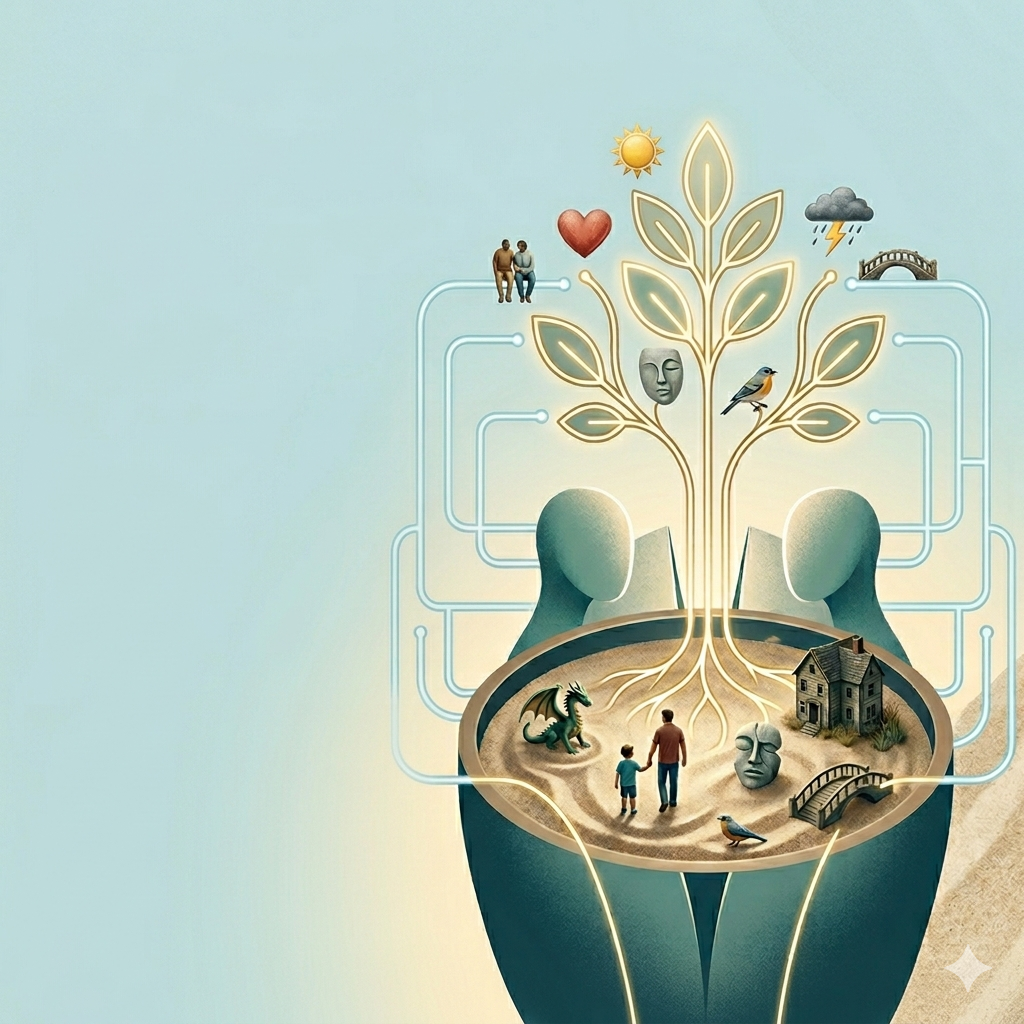
There is a part of the human mind that has never learned to speak.
Long before we had language for our experiences, we had images, symbols, and story. The emotional brain — the parts of us that carry fear, longing, shame, grief, and joy — doesn't organize experience into sentences. It organizes it into pictures, sensations, and meaning that lives below the reach of words.
This is why some clients can talk about something for months and still feel like they haven't touched it. It's not resistance. It's not lack of insight. It's that they've been trying to access right-brain material through a left-brain door.
Sandtray opens a different door.
This introductory workshop is a practical, hands-on exploration of sandtray therapy for therapists who are curious about working beyond language. Using a tray of sand and a collection of miniature figures, clients are invited to build — to give external form to their internal world, to see what they're carrying, and to discover meaning through symbol and story rather than explanation and analysis.
You are not there to interpret. You are there to witness. And that distinction changes everything.
Over 2.5 hours, you'll learn the neuroscientific foundations that make sandtray clinically coherent, explore four practical applications you can begin integrating immediately, and — most importantly — get your own hands in the sand. We'll use sandtray to take a broad view of a client's world, map out a specific problem or life situation, explore family and relational patterns through a living genogram, and give form to the internal schemas and learned responses that shape how clients move through their lives.
The workshop is experiential by design. You cannot invite a client into an experience you have never had yourself. Participants will have the opportunity to build their own trays and practice holding space for a partner — learning what it feels like to witness without interpreting, and to ask questions without offering answers.
No prior experience with sandtray is required. All materials are provided. What you'll need is curiosity, a willingness to get a little bit out of your head, and an openness to what shows up when you stop looking for the words.