
ADHD or Digital Overstimulation? Understanding Attention in the Age of Social Media

How is social media affecting our understanding and identification with ADHD?

This post is for educational purposes only. It does not constitute therapy or a diagnosis. Please consult a qualified professional if you have concerns about ADHD, attention, or mental health.
Quick Answer: Heavy social media use may mimic some attentional patterns seen in ADHD, but this does not mean a formal diagnosis applies. A qualified clinician is needed to assess attention differences.
Rosenhan’s Study and the Power of Labels
Fifty-one years ago, David Rosenhan published his seminal study, On Being Sane in Insane Places. He aimed to examine how psychiatric labels affect the perception of behavior. In his experiment, individuals with no history of psychopathology presented themselves at psychiatric hospitals and were admitted with diagnoses such as schizophrenia or bipolar disorder. Staff often interpreted ordinary behavior—like taking notes—as pathological.
Later methodological reviews raised serious questions about aspects of Rosenhan's data — some researchers have argued certain details may have been fabricated or embellished, though this remains debated among historians of psychiatry rather than settled fact. Regardless of how that debate resolves, the study's central question still resonates: how much of what we "see" depends on the lens we're wearing? Rosenhan's work raised enduring questions about how easily behaviour can be pathologized and how powerfully labels shape interpretation.
Today, a parallel dynamic can be observed in digital environments. Emerging research suggests that heavy social media use may be associated with attentional patterns that resemble ADHD-like symptoms, not necessarily because of intrinsic neurodevelopmental differences, but potentially due to the effects of constant digital stimulation. In online spaces, such experiences are sometimes interpreted or self-labeled as neurodivergence.
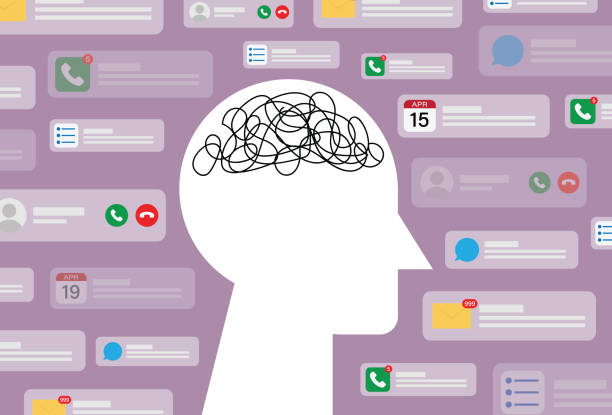
A growing body of research explores the relationship between problematic social media use and attentional difficulties. Individuals who frequently switch between apps and offline tasks may experience reduced ability to filter irrelevant information, mirroring the distractibility often associated with ADHD. Highly stimulating, short‑form content can also shift one’s baseline for engagement, making sustained‑attention activities feel comparatively understimulating. Boer et al. (2020) note that adolescents may develop compulsive checking behaviours — refreshing feeds, responding instantly to notifications — which further fragment attention and strain executive control.
Social Media and Attention: What We Know
A growing body of research explores how frequent switching between apps and offline tasks can affect the ability to filter irrelevant information, which may resemble distractibility often associated with ADHD. Highly stimulating, short-form content may also shift one’s baseline for engagement, making sustained-attention activities feel comparatively understimulating.
Boer et al. (2020) note that adolescents may develop patterns of compulsive checking—refreshing feeds, responding quickly to notifications—that fragment attention and challenge executive control.
For individuals with ADHD, these platforms may be particularly engaging. Research indicates that ADHD is associated with differences in working memory, response inhibition, and reward processing, which may increase susceptibility to the rapid, unpredictable reinforcement cycles built into social media. Consequently, intense social media use may mimic ADHD-like attentional patterns in some individuals and amplify existing challenges for those with a formal diagnosis.
Self-Identification and Online Communities
The distinction between ADHD and attentional difficulties influenced by digital environments is not always clear to the general public. In online communities such as “ADHDTok,” ADHD symptoms are often represented through everyday experiences—procrastination, forgetfulness, daydreaming—that resonate widely.
Holroyd (2025) suggests that these representations can blur the boundaries between clinical symptoms and common experiences, potentially making ADHD feel more like a shared identity than a strictly medical diagnosis. Importantly, self-identification in these spaces does not replace formal assessment or diagnosis. For many, identifying with ADHD online is less about seeking a medical label and more about finding a vocabulary for a shared way of moving through a world that wasn't built for them.


ADHD-adjacent content can reflect digital life realities: fragmented attention, constant stimulation, and difficulty sustaining focus. These online representations may help some individuals recognize patterns that warrant professional evaluation, humanize ADHD, reduce stigma, and foster supportive communities.
The question, then, is not simply whether one’s inattention arises from ADHD or from digital overstimulation, but how these experiences can be understood and supported. During Rosenhan’s era, access to care was tightly bound to diagnostic labels, often in ways that were stigmatizing or harmful. Today, psychotherapy is less about confirming or denying labels and more about helping individuals make sense of their inner and outer worlds. Therapy offers a space to slow down, reorient, and reconnect with one’s capacity for focus, meaning, and agency.
Ultimately, the question is not whether one’s inattention arises due to ADHD or excessive social media use, but how it can be meaningfully addressed. During Rosenhan’s study, people could only access care if they had a particular diagnosis, which was commonly stigmatizing and harmful. Today, the goal of psychotherapy is not to confirm or deny those labels, but to help individuals reclaim agency over their inner and outer worlds. Therapy offers a space to slow down, reorient, and reconnect with one’s capacity for focus and meaning.

In an age where the boundaries between adaptation and pathology are increasingly blurred, perhaps the most compassionate response is neither to over-pathologize nor to dismiss. Instead, we can meet each person where they are — not as diagnoses, but as human beings navigating a digital landscape that both shapes and strains our cognitive capacities.
Therapy in the Digital Age
In psychotherapy today, the focus is on understanding experiences rather than confirming or denying labels. Therapy offers a space where individuals can reflect on attention, focus, and engagement, guided by a qualified professional, without being pressured to fit a diagnostic box.
Rather than over-pathologizing or dismissing experiences, a compassionate approach recognizes that attention and focus can be shaped by both intrinsic traits and environmental factors—including the digital landscape. Practitioners may explore strategies that help individuals regulate stimulation, reflect on digital habits, and strengthen cognitive engagement, always within the context of professional care.
In a culture that demands constant "writing behavior" (to borrow from Rosenhan’s observers) and instant digital responsiveness, the act of slowing down is a radical form of self-care. Therapy at Vistas Psychotherapy & Wellness isn't about fitting you into a diagnostic box or debunking your lived experience. Instead, it’s a dedicated space to:
- Audit your digital nervous system: Identifying which "pings" are protective and which are depleting.
- Widen your Window of Tolerance: Learning to sit with the "under-stimulation" of real life without reaching for a screen.
- Reclaim Agency: Moving from a state of being "reacted to" by notifications to a state of acting with intention.
If you’re feeling "digitally fried" and aren't sure where the environment ends and your internal wiring begins, you don’t have to untangle it alone. We’re here to help you find the ground again.
Key Takeaways
- Patterns of attention are multifactorial. Social media may influence attentional patterns, but this is not equivalent to a formal ADHD diagnosis.
- Online self-identification is informative, not diagnostic. Communities can support recognition and coping, but professional assessment remains essential.
- Therapy provides reflection, not labels. Any interventions should be guided by qualified clinicians and tailored to the individual.
- Disclaimers matter. This content is educational only and does not establish a therapeutic relationship.
This post offers general information for educational purposes. It is not therapy, does not replace individualized mental‑health care, and does not establish a therapeutic relationship. If you’re experiencing distress or need support, please connect with a qualified mental‑health professional in your area. If you are in immediate distress or at risk of harm, in Canada you can call or text 9‑8‑8 (Suicide Crisis Helpline) or call 9‑1‑1, and internationally you can visit FindAHelpline.com to locate free, confidential support services available in your specific country and language.
Written by a student contributor and reviewed for general accuracy by a Registered Psychotherapist.
Frequently Asked Questions (FAQ)
Q1: Can social media cause ADHD?
A: Social media does not cause ADHD, which is a neurodevelopmental condition. However, research suggests that heavy digital stimulation may mimic ADHD-like attention patterns in some individuals. Anyone concerned about attention differences should seek evaluation from a qualified mental health professional.
Q2: How can I tell if my attention difficulties are ADHD or just digital fatigue?
A: It can be difficult to distinguish. Attention challenges from digital overstimulation may look similar to ADHD symptoms but do not necessarily indicate a formal diagnosis. Professional assessment is the best way to understand the underlying cause and develop individualized strategies.
Q3: Is it safe to self-identify with ADHD based on online communities?
A: Online communities can help people feel seen and find shared strategies, but self-identification does not replace professional evaluation. If you suspect ADHD or attention difficulties, consult a qualified clinician for assessment and guidance.
Q4: How can therapy help with attention challenges in a digital world?
A: Therapy provides a space to explore patterns of attention, reflect on environmental influences, and develop coping strategies. Therapists do not confirm or deny diagnoses online—they guide individuals toward safer, evidence-informed ways to manage focus and engagement.
Q5: Are children or adolescents more affected by digital attention challenges?
A: Some research indicates that adolescents may be particularly sensitive to attention fragmentation from social media use. Caregivers and clinicians can support healthy digital habits while monitoring for signs that warrant professional assessment.
Q6: What steps can I take if I feel digitally overstimulated?
A: Strategies include setting boundaries on device use, taking regular breaks, and practicing focused attention exercises. If digital overstimulation is affecting daily functioning, consider consulting a mental health professional for individualized guidance.
References and Further Reading
Boer, M., Stevens, G., Finkenauer, C., & van den Eijnden, R. (2020). Attention Deficit Hyperactivity Disorder-Symptoms, Social Media Use Intensity, and Social Media Use
Problems in Adolescents: Investigating Directionality. Child development, 91(4),
e853–e865. https://doi.org/10.1111/cdev.13334
Dekkers, T. J., & van Hoorn, J. (2022). Understanding Problematic Social Media Use inAdolescents with Attention-Deficit/Hyperactivity Disorder (ADHD): A Narrative Review
and Clinical Recommendations. Brain sciences, 12(12), 1625.
https://doi.org/10.3390/brainsci12121625
Holroyd, D. (2025). ‘Why is everyone self-diagnosing with ADHD nowadays?’: the affective economy of ADHD TikTok. Continuum, 1–14. https://doi.org/10.1080/10304312.2025.2544777
Rosenhan, D. L. (1973). On being sane in insane places. Science, 179(4070), 250–258.