

Why Therapist Profiles All Sound the Same (And How to Choose the Right Therapist)

How to Choose a Therapist: What Psychology Today Profiles Actually Tell You
Welcome to the Great Therapist Ad Copy Clone Wars
This is gentle satire aimed at therapists (myself included), not at people seeking support.”
You’ve seen them. You’ve scrolled past them. You may have even written one yourself (no judgment — I have too). The classic Psychology Today therapist ad: part heartfelt invitation, part acronym soup, part existential shrug.
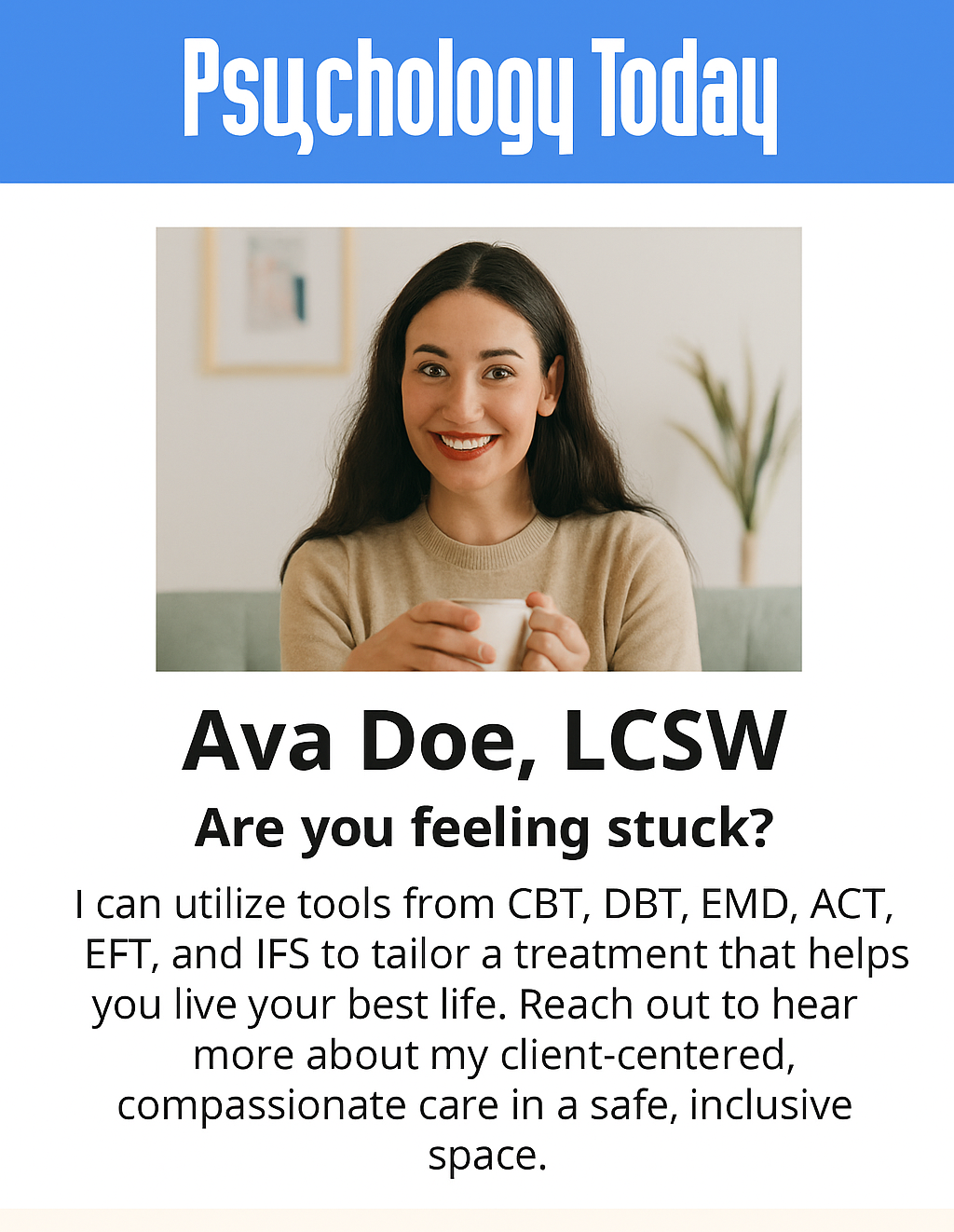
They all start the same way:
“Are you feeling stuck, overwhelmed, or just not like yourself?”
And they all end the same way:
“Let’s walk together on your healing journey.”
In between? A gentle avalanche of buzzwords, credentials, and promises of a “safe, inclusive space” where your “authentic self” can “show up fully.” It’s like Mad Libs for mental health professionals.
So in the spirit of loving mockery and client-centered clarity, I present to you:
Every Psychology Today Ad Ever Written
(Reminder here, this is parody intended to let all of us therapists laugh at ourselves - me included - and not a real ad!)
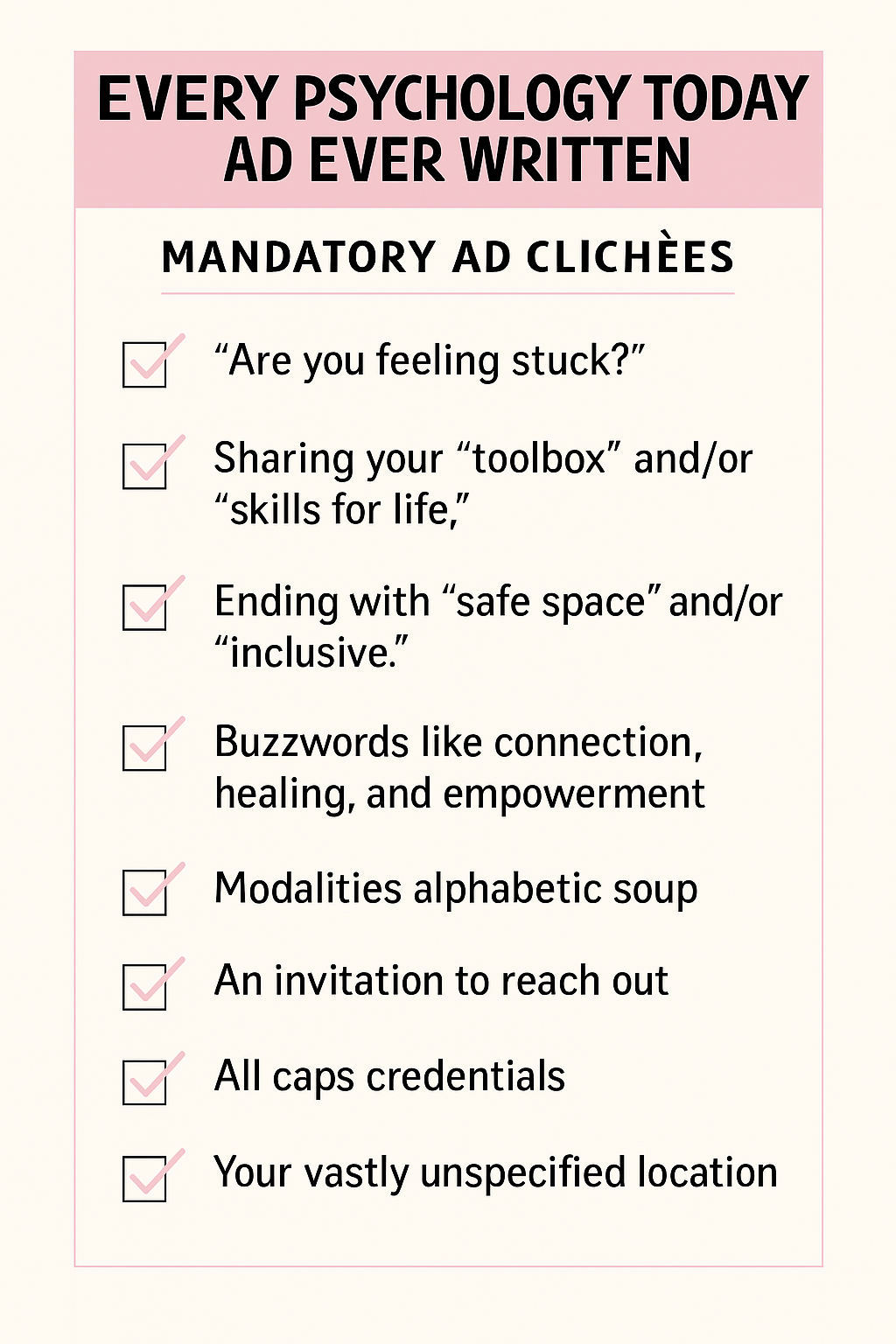
“Are you feeling stuck, overwhelmed, or just not like yourself? You don’t have to go through this alone.”
Hi, I’m [Insert Name, MA, PhD, ABC, XYZ, BBQ], and I’m here to walk alongside you on your healing journey. My approach is warm, collaborative, and client-centered. I draw from a trauma-informed, integrative framework that includes CBT, DBT, EMDR, ACT, EFT, IFS, and sometimes just sitting in silence and nodding empathetically.
I specialize in:
- Anxiety, depression, stress, burnout, existential dread, and “just life stuff”
- Relationships (with others, yourself, your inner child, your barista)
- Identity exploration, including but not limited to: gender, culture, career, and whether you’re a “dog person” or just lonely
My clients describe me as “compassionate,” “nonjudgmental,” and “someone who once mentioned attachment theory in a way that made sense.”
I offer a safe, inclusive, and affirming space for all, including people who have read The Body Keeps the Score but still aren’t sure what their body is saying.
I offer virtual, in-person, or sessions via carrier pigeon (kidding—definitely just virtual and in-person).
Let’s connect — because healing isn’t linear, but your therapist’s font choices can be.
Why All the Jargon? And What You Actually Need to Know
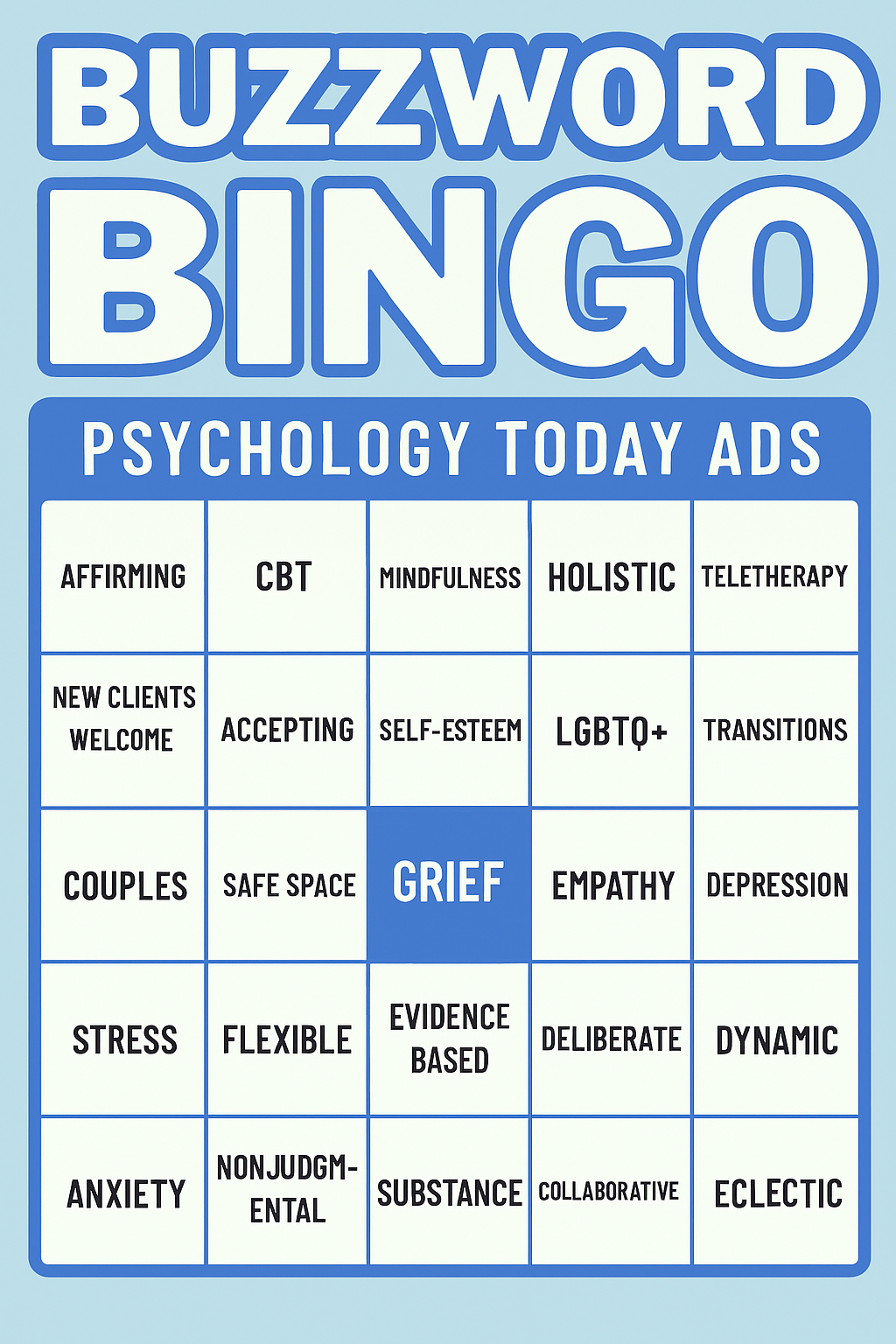
Therapist ads are full of buzzwords — “integrative,” “trauma-informed,” “client-centered,” “safe space,” “healing journey.” These phrases aren’t meaningless, but they’ve become so overused that they start to blur together. It’s like every therapist is reading from the same script, hoping the right acronym (CBT! EMDR! ACT!) will catch your eye.
So why does this happen?
- Regulatory pressure: Therapists are trained to speak in frameworks and modalities. It’s how we prove we’re qualified.
- Marketing anxiety: We want to sound professional, inclusive, and competent — without scaring you off.
- Fear of being too human: Vulnerability is our job, but writing about ourselves? Terrifying. So we hide behind the language of “holding space” and “walking alongside.”
But here’s what you actually need to know when choosing a therapist:
- Do they feel real to you? If their ad sounds like a robot wrote it, they might not be the right fit.
- Can you imagine talking to them when you’re at your worst? That’s the real test.
- Do they explain things in a way that makes sense to you — not just to other therapists?
- Are they clear about logistics? Fees, availability, how to book — if that’s confusing, it may be a sign you want to ask more questions. Ensure you feel comftable to ask the questions you need to ascertain the clarity you require to feel good about moving forward.
Credentials matter, but the relationship and fit are often just as important. It’s about finding someone who gets you, challenges you, and makes you feel safe enough to be honest.
So read between the lines and trust your gut. The right therapist won’t just say they’re client-centered — they’ll show it, from the first click to the first session.
Another thing - every therapist knows that the secret sauce to good therapy is the right click between client and therapist. Many therapists offer free consults because fit matters, and it’s a helpful way to get a sense of the relationship before committing
What to Look for When Choosing a Therapist
If you’re browsing therapist profiles on directories like Psychology Today, a few things can help you decide who might be a good fit:
1. Clarity about logistics
Good therapist profiles usually explain fees, availability, and whether they offer virtual or in-person sessions.
2. A sense of the therapist’s personality
Therapy is relational. Look for someone whose writing style feels comfortable or approachable.
3. Areas of focus
Many therapists specialize in concerns like anxiety, trauma, relationships, or life transitions.
4. Your own gut reaction
Research consistently shows that the therapeutic relationship is one of the strongest predictors of therapy outcomes.
Want to Know More About Me? Here's a Bit About my Approach
A Little Bit About My Approach
Hi, I’m Amanda — a Registered Psychotherapist and clinic leader. I believe that while professional frameworks are the backbone of safe therapy, the conversation itself should feel like it's happening between two real people, not a clinician and a specimen.
In my practice, I work with folks navigating anxiety, trauma, burnout, and the general complexity of being human. I aim to blend evidence-based tools (like EMDR and a focus on what the research shows actually works in the room) with a deep respect for your lived experience.
My Style:
- Interactive: I’m not a "silent nodder." I believe in being an active participant in your process.
- Grounded: I use metaphors and a bit of humor when it fits, but my primary goal is to help you find clarity that makes sense to you.
- Direct & Warm: I strive to be clear about the "how" and "why" of our work so you never feel lost in a maze of acronyms.
The Logistics: I’m based in Toronto and South River, offering virtual sessions across Ontario. I also provide clinical supervision and love helping people find the right therapeutic "click"—whether that’s with me or someone else. I’m always happy to help you think through what you’re looking for and offer suggestions if a different fit would serve you better.
Let’s Connect! If you’re curious or even a little skeptical about how this all works, I’d be honoured to chat. I offer free consultations so we can see if my style aligns with what you need. No jargon, no pressure—just a real conversation.
If you’re curious about how therapy works at Vista’s Wellness, you can learn more about our approach here.
Don’t take my word for it — reach out today for a free consult.
If you’re looking for therapy in Toronto or Ontario, directories like Psychology Today can be a helpful starting point—but the best next step is usually reaching out for a consultation to see if the fit feels right. Whether you’re curious, skeptical, or just sorting through options, this is your chance to ask questions, get clarity, and see if we’re a good fit. No pressure, no jargon — just a real conversation about what you need and how I might help.
This post offers general information for educational purposes. It is not therapy, does not replace individualized mental‑health care, and does not establish a therapeutic relationship. If you’re experiencing distress or need support, please connect with a qualified mental‑health professional in your area. If you are in immediate distress or at risk of harm, in Canada you can call or text 9‑8‑8 (Suicide Crisis Helpline) or call 9‑1‑1, and internationally you can visit FindAHelpline.com to locate free, confidential support services available in your specific country and language.