
Can Ontario Therapists Practice in BC? Cross-Border Rules, Risks & What to Know

This post is for general education purposes only and is not legal or professional advice. For questions about your specific situation, always consult your regulatory college or legal counsel. If you are working under supervision, check in with your supervisor before making decisions about cross‑border work. Clinicians are responsible for understanding the requirements in the jurisdictions where they practise, and many find it helpful to document communication with regulators and speak directly with their insurance provider to clarify coverage. I am not a legal expert, nor do I speak for any regulatory body. The following points are here to serve as a spring board for reflective thought to help guide you in points you should consider as you decide whether or not to engage in cross-border therapy and to draw your attention to angles you may not previously have considered.
This post is intended for:
- Registered Psychotherapists (RPs) in Ontario
- Therapists providing virtual therapy across provinces
- Clinicians with clients who travel for work, school, or vacation
When Your Client Suddenly Announces They’re “Just Popping Over to Nova Scotia”
If you’re a registered psychotherapist in Ontario wondering whether you can see a client in another province after they casually mention they’ll be in another province—or another continent—right before your next session, you probably know the feeling that follows: Wait… am I allowed to do this? You’re not alone—cross-border therapy in Canada is one of the most common and confusing questions clinicians face.
Cross‑border therapy looks simple on the surface, but once you start digging into the rules, it can feel a bit like assembling IKEA furniture without the instructions. Virtual care dissolved geographic walls, but it also created new regulatory questions. Clients travel, study abroad, take remote jobs, or split time between provinces. Therapists want continuity of care. Regulators want clarity. And somewhere in the middle sits you, typing “Can I see a client who is in Alberta for two weeks???” into your search bar at 11:47 p.m.
For therapists based in Ontario or Toronto offering virtual care, these rules are especially important when working with clients who travel frequently.
Quick Answer: Can Ontario therapists see clients in another province?
In many cases, Ontario Registered Psychotherapists (RPs) may be able to continue seeing clients who are temporarily in another province, depending on the destination province’s regulations, the length of the client’s stay, and the therapist’s insurance coverage. Because rules vary across Canada, therapists should confirm requirements with the relevant provincial regulator before providing cross-border care.
Cross‑Border Therapy: Like Driving in France… But With More Paperwork
One of the most common questions CRPO receives is about cross‑border therapy: Where can I practise, and what rules apply when my client is in another province or country?
A surprising but important truth: CRPO cannot tell you whether you’re allowed to practise in another province. The College only regulates psychotherapy within Ontario. It has no authority to interpret or enforce the laws of Alberta, British Columbia, Quebec, or any other jurisdiction.
It’s a bit like asking the Ontario Ministry of Transportation whether you’re allowed to drive in France—they can confirm your Ontario licence is valid, but they can’t tell you the speed limits in Paris.
To understand whether you can practise elsewhere, you need to check with the regulator in the jurisdiction where the client is physically located.
A general principle used across many regulated professions is that regulation tends to follow the client’s location. If your client is physically in Nova Scotia during your session, then for regulatory purposes, you may be considered to be practising in Nova Scotia—even if you’re sitting in Toronto. This applies whether the session is virtual or in person. Because each province has its own legislation, it’s wise to confirm this directly with the regulator in the client’s location. In cross-border care, you are effectively standing in two rooms at once. You must meet the standards of the CRPO (where you are) AND the requirements of the regulator where your client is. If their rules are stricter than Ontario’s, the stricter rule usually wins. While client location is the primary rule, legal jurisdiction can be complex and may involve multiple factors.
Common Mistakes in Cross-Border Therapy
Therapists navigating cross-provincial care often run into challenges such as:
- assuming “Canada-wide” insurance automatically covers all jurisdictions
- relying on informal rules (e.g., short-term travel exceptions) without confirming with regulators
- overlooking differences in mandatory reporting laws
- continuing therapy during long-term relocations without reviewing licensing requirements
Avoiding these pitfalls can significantly reduce both legal and professional risk.
Why Title Protection Matters When Clients Move Around

Protected titles vary across Canada. “Registered Psychotherapist” is an Ontario‑specific title. In New Brunswick, for example, the protected title is “Licensed Counselling Therapist.” Using a title that isn’t recognized in another province may be interpreted as presenting yourself as a regulated professional in a jurisdiction where you are not registered.
This isn’t just a technical detail. Title protection exists to safeguard the public, ensure accountability, and prevent confusion about who is regulated by whom. Because each province has its own rules, it’s important to confirm title requirements directly with the regulator in the client’s location.
When working cross-border, consider adding a line to your signature: 'Registered Psychotherapist (Ontario). This practitioner is not registered in [Client's Province] and provides services under the interjurisdictional provisions of [Regulator Name].
Understanding these boundaries helps clinicians navigate cross‑border work with clarity and integrity—and helps clients understand who is regulating their care.
The Controlled Act of Psychotherapy Explained (Without the Legal Headache)
In Ontario, psychotherapy includes a legally defined Controlled Act. The Controlled Act involves treating, by means of psychotherapy technique, delivered through a therapeutic relationship, an individual’s serious disorder of thought, cognition, mood, emotional regulation, perception or memory that may significantly impair judgment, insight, or functioning. Only members of specific regulated colleges—such as Registered Psychotherapists, Psychologists, Social Workers, Nurses, Occupational Therapists, and Physicians—are authorized to perform this act and are regulated by their respective colleges.
This distinction exists to ensure that individuals receiving treatment for serious mental health concerns are supported by professionals with appropriate training, oversight, and accountability. This is a simplified overview; the full legal definition includes additional context and exceptions.
Protected Titles Across Canada: RP Here, LCT There
Across regulated provinces, it is generally not allowed present yourself as a Psychotherapist unless you are formally registered with the appropriate regulatory body. Title protection ensures that anyone using a professional title has met established standards, completed recognized education, accumulated supervised hours, passed required exams, and maintains liability insurance and ethical accountability.
Because each province’s legislation is different, clinicians are encouraged to confirm title requirements directly with the regulator in the client’s location.
CRPO’s Requirement: Standard 3.4 (Electronic Practice)
CRPO has one key requirement related to cross‑jurisdictional work. Standard 3.4 states that Registered Psychotherapists must comply with the licensing laws of the jurisdiction where the client is physically located. In practice, this means CRPO does not prohibit you from working with clients outside Ontario, but it does expect you to follow the laws of the client’s location.
This places responsibility on the clinician to understand the rules that apply in the client’s jurisdiction.
What to Do Instead of Calling the CRPO
Because the CRPO cannot give case‑specific approval for cross‑border practice, therapists are encouraged to use alternative, more authoritative resources. The CRPO’s Cross‑Border Therapy Tool offers a self‑assessment that helps you think through jurisdictional considerations without providing formal advice. You should also contact the regulator in the client’s province as they are the only body that can give a definitive "yes" or "no" regarding your ability to practise there.Professional associations such as the CCPA or OSRP can also be valuable supports; as advocacy organizations rather than regulators. The CCPA also provides a cross provincial therapy guide that many clinicians find useful even offers their own excellent guide on cross provincial border therapy here. While associations like the CCPA provide excellent 'roadmaps,' the Provincial Regulator is the only one holding the 'keys.' If a CCPA guide says 'yes' but a Provincial Registrar says 'no,' the Registrar always wins
A brief summary of provincial regulation and regulator contact information can be helpful as an orientation tool, but it should always be treated as general information rather than a substitute for direct confirmation.
Therapy Without Borders (But With Rules): Understanding the Client's Province
When a client receives psychotherapy while physically located in another Canadian province, the therapist must follow the laws of that province—not only Ontario’s. This includes legislation related to mandatory reporting, child protection, adult protection, health privacy, and, in some cases, professional conduct.
Even though the therapist is registered in Ontario, they may also be accountable under the laws of the province where the client is located during the session. Understanding these local requirements supports safe, ethical, and compliant cross-provincial practice.
Mandatory Reporting Laws Vary Across Provinces
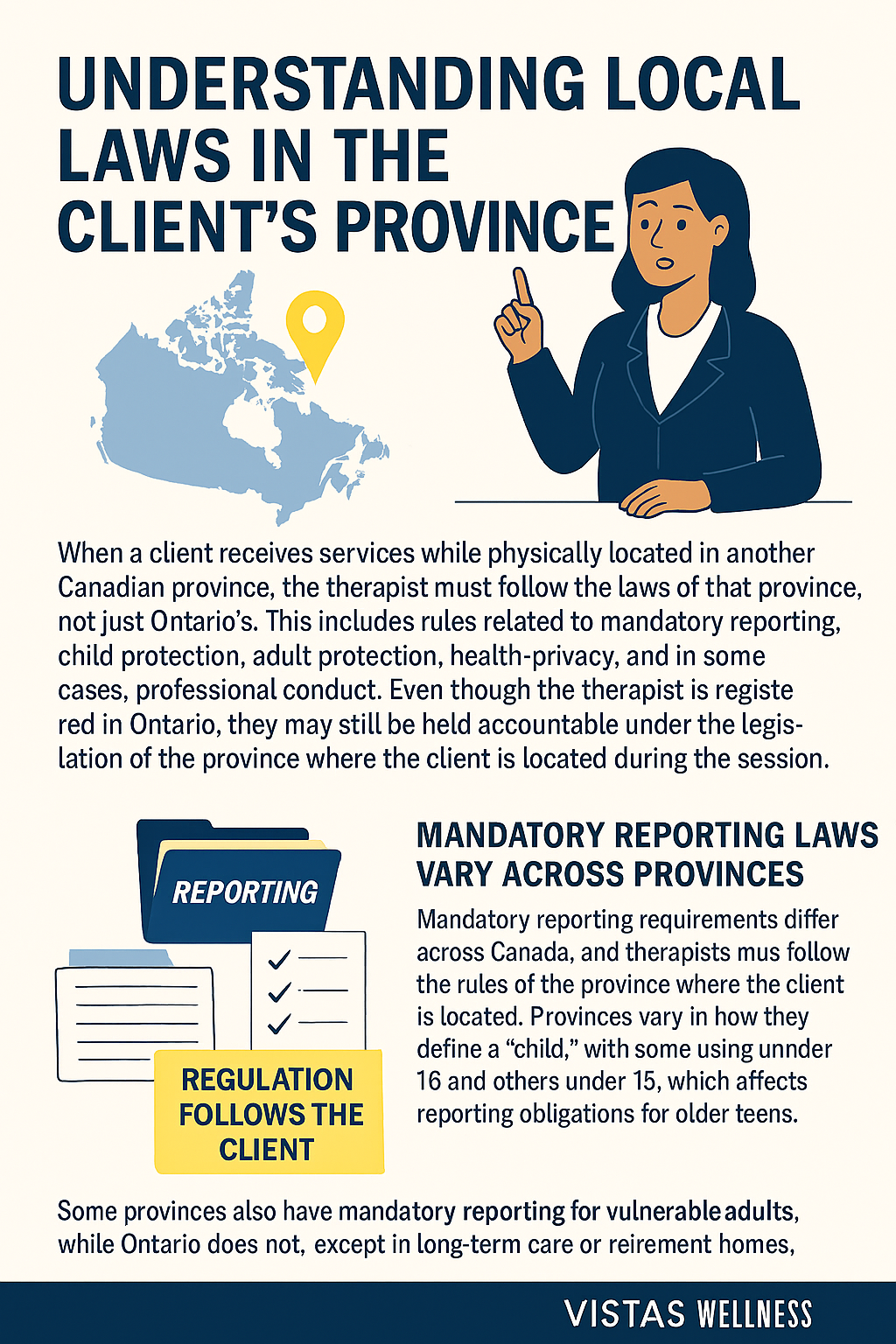
Mandatory reporting requirements differ across Canada, and therapists are generally expected to follow the rules of the province where the client is physically located.
These differences can include:
- How “child” is defined: Some provinces define a child as under 16, others under 18, which can affect reporting obligations for older teens.
- What must be reported: Some provinces require reporting risk of harm or exposure to intimate partner violence; others require evidence of abuse or neglect.
- Where reports are made: Reporting pathways vary—some provinces use centralized intake lines, while others use regional agencies or Indigenous child-welfare authorities.
- Adult-protection laws: Several provinces have mandatory reporting for vulnerable adults; Ontario generally does not, except in specific settings such as long-term care or retirement homes.
- Duty to warn or protect: Some provinces have explicit statutory duties, while others rely on common-law principles.
Because these variations can meaningfully affect clinical decision-making, therapists should understand the reporting rules of the client’s temporary province.
When laws appear to conflict, a cautious approach is to follow the higher standard of care where appropriate. For example, if one jurisdiction requires reporting in a situation where another does not, making the report may better support client safety—however, this should be considered in light of the specific legal context and, where needed, consultation.
Health‑Privacy Laws Also Differ Between Provinces
Each province has its own health privacy legislation governing how personal health information is collected, stored, shared, and disclosed. While the overarching principles are similar, the details can differ.
Variations may include:
- whether consent for disclosure must be express or can be implied
- timelines for granting clients access to their records
- exceptions to consent requirements
- record-retention periods (which may vary by jurisdiction)
- rules about storing health information outside Canada (which may be stricter in provinces such as BC and Nova Scotia)
- when information may be disclosed without consent, particularly in safety-related situations
When a client is located in another province, therapists should take reasonable steps to ensure their privacy practices align with that province’s legislation.
How we handle this at Vistas: To support compliance with privacy expectations across jurisdictions, our clinic utilizes Owl Practice, which is platforms designed to align with PHIPA and PIPEDA requirements. These systems store client data on Canadian servers, which may help meet data residency expectations in provinces such as British Columbia. You can read more about our data-handling and encryption standards in our Clinic Privacy Policy.
If this sounds like a lot to keep track of—it is. Comparative charts can help clinicians orient themselves to the differences, but these should always be treated as general reference tools rather than substitutes for reviewing the legislation directly.
Applying This Knowledge in Practice
Before offering interprovincial services, therapists can take steps such as:
- identifying the province where the client will be located
- reviewing that province’s child-protection, adult-protection, and privacy laws
- documenting that relevant legislation was reviewed
- adjusting consent forms or session structure if needed
- clarifying with the client how reporting and privacy obligations may differ
These steps demonstrate thoughtful, responsible practice and help protect both the client and the therapist.
Contracts and Informed Consent for Electronic Practice
In Ontario, CRPO requires therapists to establish a clear contract with clients before beginning electronic practice. This helps address jurisdictional risks that standard consent forms may not fully cover—particularly when clients are located outside Ontario.
If, after reviewing relevant considerations, you decide to proceed with cross-border therapy, it may be helpful to implement a dedicated telehealth informed-consent policy tailored to this context.
A sample policy can be adapted to your practice to ensure clients understand the legal and practical considerations involved. Be sure to have your own personalized version of your policy reviewed by a legal professional before relying on ours.
Out‑of‑Province and Out of Office: Can Therapy Travel Too?
Can I see a Client who is Temporarily Cross-Border?
The “Insignificant Connection” Concept
In some provinces, a commonly referenced grey zone—sometimes described as an “insignificant connection”—may apply when a client who normally resides and receives therapy in your home province is temporarily travelling.
This is an informal concept used in some regulatory discussions and is not consistently defined or applied across jurisdictions.
It is often understood to apply when:
- the client is away briefly (e.g., a short vacation or business trip)
- the therapist is not marketing services to residents of the other province
- the session is part of continuity of care within an existing therapeutic relationship
Because this is not a formal legal category, therapists should confirm expectations directly with the regulator in the client’s temporary province.
The concept can be a helpful framework for thinking about risk, but it is not a guarantee of compliance. The shorter the trip, the lower the likelihood of regulatory concern—however, the legal responsibility to follow local laws still applies.
The shorter the trip, the lower the risk—but the legal responsibility to follow local laws remains at 100% from Day 1."
Considerations Before Agreeing to an Out‑of‑Province Session
Duration and Intent
Short absences—often in the range of 7 to 14 days—may be considered continuity of care in some contexts. Longer stays (e.g., a semester or seasonal relocation) generally require reviewing the destination province’s registration requirements.
The “Risk of Harm” Rule
If a client is experiencing elevated risk (e.g., active suicidal ideation), cross-provincial work becomes more complex. Therapists may wish to:
- identify local crisis resources
- understand how to coordinate with emergency services in the client’s location
- confirm that liability insurance may respond to concerns arising in that jurisdiction
Cautious Practices for Registered Psychotherapists
When proceeding with a brief out-of-province session, therapists can document:
- the rationale for the session (e.g., continuity of care)
- the exact locations of both client and therapist
- an emergency plan, including the client’s temporary address and nearest emergency department
- that relevant regulatory information was reviewed
For clients located in Quebec, therapists may be able to provide services in some circumstances. However, Quebec has distinct regulatory frameworks, and therapists should verify applicable requirements. Clients can also be informed about how complaints processes may differ.
The Three‑Hour Informal Rule
Some provinces—particularly in the Atlantic region—have historically referenced informal agreements or Memoranda of Understanding that allow limited, short-term support without full registration.
These allowances are not standardized and may change. Reported limits (e.g., a small number of hours per year) should be treated cautiously and verified directly with the relevant regulator.
Many jurisdictions are moving toward formal temporary or emergency registration categories. Therapists should always review the most current “interprovincial practice” policies from the destination regulator.
Contacting the “Away” Regulator
If a client will be away for an extended period, therapists may consider contacting the regulator in that province.
Keeping a written response can support documentation and demonstrate due diligence.
When to Decline
Therapists may need to pause or transition care when:
- the client is relocating permanently
- insurance may not cover the client’s location
- the destination province requires registration that the therapist does not hold
Creating a Vacation Policy
To reduce uncertainty, therapists can develop a Vacation Policy within their informed‑consent or service‑agreement documents. This policy outlines expectations before a client travels so both parties understand the parameters of care.
A handout summarizing regulatory contacts and provincial regulation status (current as of December 2025) can support this process, but clinicians should always confirm details directly with the local regulatory body and document any communication.
When Clients Leave Canada: Understanding the Shift From Provincial to International Risk
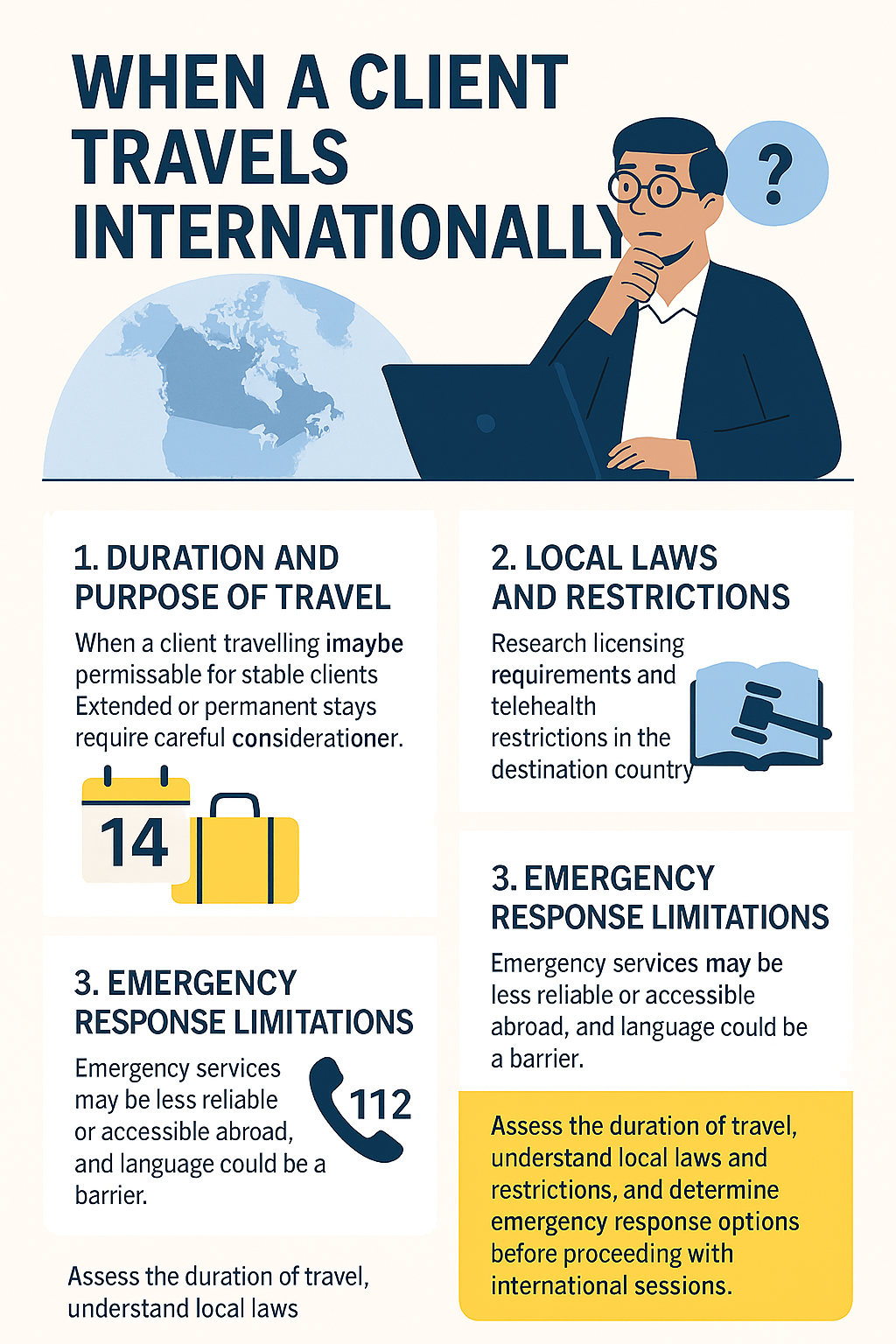
When clients leave Canada, the regulatory landscape becomes more complex. Laws vary widely, and therapists should exercise increased caution.
Short-term travel may, in some cases, allow for continuity of care, depending on local laws and risk considerations. Longer stays or relocation generally require more thorough review of legal and practical constraints.
Therapists are not expected to be legal experts in foreign jurisdictions, but they are expected to demonstrate reasonable due diligence by reviewing publicly available information and, where appropriate, seeking consultation.
2. Local Laws and Restrictions
Each country has its own approach to regulating mental‑health services. Before providing international sessions, therapists can consider questions such as:
- Does the country require foreign clinicians to hold a local licence?
- Are there restrictions on telehealth delivered from outside the country?
- Are certain titles or therapeutic activities protected or prohibited?
- Does the country regulate psychotherapy at all?
Many U.S. states have strict licensing and scope-of-practice laws. In many cases, providing even a single session to a client located in the U.S. without appropriate authorization may be considered unauthorized practice. Requirements vary by state and should be confirmed directly.
3. Emergency‑Response Limitations
Emergency response becomes more complex internationally. Therapists should consider:
- local emergency numbers
- availability of crisis services
- language barriers
- feasibility of coordinating emergency support
Because of these factors, sessions with elevated-risk clients should be approached with particular caution.
The Real Risk in Cross‑Border Therapy: Your Insurance
It's all about insurance

When therapists think about cross‑border work, the first worry is usually the regulator. But the real vulnerability often sits somewhere else entirely: your insurance provider. Both regulatory compliance and insurance coverage are critical and interdependent.
Regulation determines whether you’re permitted to practice.
Insurance determines whether you’re protected if something goes wrong.
A therapist may be fully compliant with another province’s laws, but if their insurance doesn’t cover that province—or doesn’t cover the way the service was delivered—they may be exposed to significant financial and professional risk. Many clinicians assume their liability insurance automatically applies across Canada. While policies often appear “Canada‑wide,” the fine print can contain important limitations that become highly relevant when working with clients located in other provinces or countries.
Before offering cross‑border services, it’s helpful to review your policy carefully and, ideally, obtain written clarification from your insurer. Key areas to examine include jurisdictional coverage, territorial limits, lawful‑practice requirements, disciplinary defence provisions, cyber liability, and how the policy defines “professional services.
Canada‑Wide? Maybe. Maybe Not.
Insurance Red Flags for Cross‑Border Therapy
1. Jurisdictional Limits
Many policies state they are valid across Canada, but some restrict coverage depending on where a lawsuit or complaint is filed. If a client located in Alberta files a complaint or legal action, the matter may be heard in Alberta. Certain Ontario‑based policies only cover legal defence for cases heard within Ontario. Therapists can confirm whether their policy covers legal defence in any Canadian jurisdiction where a client might initiate a complaint.
2. Territorial Limits
Territorial limits determine where the service must be delivered in order to be covered. Some policies only apply when both therapist and client are physically located within Canada. If either party is abroad—even temporarily—coverage may not apply. This becomes especially important when clients travel internationally or when therapists provide sessions while outside the country. Therapists can verify whether their policy covers services delivered across borders or only within Canadian territory.
3. Lawful Practice Requirement
Many policies include a clause stating that coverage applies only when the therapist is practising in accordance with the laws of the jurisdiction where the client is located. This is one of the most common reasons insurers deny claims. If a therapist provides psychotherapy to a client in another province without meeting that province’s requirements, the insurer may determine that the therapist was not practising lawfully in that jurisdiction. Ensuring compliance with local laws supports both ethical practice and insurance protection.
4. Disciplinary Defence Coverage
Many policies include a specific amount of coverage for disciplinary defence (for example, $50,000–$100,000). However, this coverage is often tied to the therapist’s home regulatory body. If a regulator in another province initiates an investigation—for example, related to title use or jurisdictional concerns—the Ontario‑based policy may not cover legal fees for responding to an out‑of‑province regulator. Therapists can confirm whether disciplinary defence applies only to their primary regulator or to any Canadian regulatory body.
5. Virtual / Cyber Endorsements
Cross‑border therapy is almost always delivered virtually, which introduces additional risks. Therapists can ensure their policy includes cyber liability coverage, particularly for privacy breaches involving clients in other provinces. If a device is stolen or compromised and the personal health information of a client in another province is exposed, the therapist may be required to follow that province’s privacy legislation, including breach‑notification requirements. Cyber coverage should clearly include costs associated with responding to privacy breaches in the client’s jurisdiction. When a client is in the EU, you are technically subject to GDPR privacy standards, which are much stricter than Ontario’s PHIPA regarding data portability and 'the right to be forgotten'.
6. Definition of “Professional Services”
Every policy includes a definition of what counts as a covered professional service. This becomes important when therapists adjust their services to comply with another province’s laws. If the service provided does not fall within the policy’s definition of covered activities, the insurer may deny the claim. Therapists can confirm that any adjusted or alternative service they provide is still covered under their policy. It is also important to remember that changing terminology does not override legal definitions of controlled acts.
7. Claims‑Made Policies
Most Canadian liability policies are “claims‑made,” meaning coverage applies only if the policy is active at the time the claim is filed—not just when the service was delivered. This matters for cross‑border work because complaints may arise months or years after the session, and potentially in another province. Maintaining continuous coverage helps ensure past cross‑border work remains protected.
8. Contractual Liability Exclusions
Some policies exclude liability arising from contracts or service agreements. Because cross‑border therapy often requires specialized consent forms or travel‑specific agreements, therapists can ensure that these documents do not unintentionally create obligations that fall outside their policy’s coverage. Reviewing contractual‑liability exclusions helps ensure that consent forms support, rather than complicate, insurance protection.
Never assume ‘Canada‑wide’ means ‘everything covered.’ Insurance companies assess risk. If your risk profile changes—such as by crossing borders—your coverage may not automatically follow.
A Practical Insurance Checklist for Therapists
To support clarity, therapists can review a set of questions with their insurance provider before engaging in cross‑border practice. A list of helpful questions is available here.
When Your Client Roams, Your Ethics Shouldn’t
Cross-border therapy can feel complex, but the core principles remain consistent: know where your client is, understand the applicable laws, prioritize safety, and document your reasoning. This guide is meant to support thoughtful, decision‑making, but it is not constitute legal advice, and I am not a legal expert. When needed, consult a lawyer familiar with health-care regulation in the relevant jurisdiction.
Many professional associations—including the CCPA—offer free or low‑cost legal consultation for members, and these services can be invaluable when navigating unfamiliar regulatory terrain.
If you're a therapist navigating cross-border practice and want support reviewing risk, documentation, or consent processes, we offer consultation and supervision support. Contact us here.
Frequently Asked Questions
Can therapists work across provinces in Canada?
In some cases, therapists may be able to provide cross-provincial care, but this depends on the destination province’s regulations and should be confirmed with the relevant regulator.
Can I see my therapist while traveling in Canada?
Clients may be able to continue therapy while traveling, particularly for short periods, but therapists must follow the laws of the province where the client is located.
Do therapists need a license in another province?
In many cases, yes—especially for ongoing or long-term care. Short-term situations may fall into grey areas, but these are not formally defined and should be verified.
What happens if a therapist is not licensed in the client’s province?
This could be considered unauthorized practice and may create both regulatory and insurance risks.
Legal & Professional Disclaimer
As a Registered Psychotherapist (RP) in Ontario, navigating the “patchwork” of provincial laws is a complex professional task. The following disclaimer is designed to support your professional boundaries and clarify the limits of this resource.
Purpose and Scope
The information provided in the charts and summaries above is for informational and educational purposes only. It offers a general overview of provincial legislation and should not be interpreted as legal advice, a legal opinion, or a substitute for professional legal counsel, nor as clinical supervision or a substitute for clinical supervision. If you have a clinical supervisor, consult with them directly before making any decisions. Regulatory compliance is an individual professional responsibility. While this guide provides a roadmap, each clinician must verify how these rules apply to their specific license and clinical context.
Laws and regulatory policies are subject to change without notice. This resource was last reviewed in March 2026. Clinicians are advised to verify the current status of legislation with the relevant College before proceeding
This content is written for therapists early in their careers. It is not therapy, clinical guidance, or professional supervision, and it does not establish a therapeutic, supervisory, or consultative relationship.
If you’re experiencing distress, please reach out to a qualified mental‑health professional. If you are in immediate distress or at risk of harm, in Canada you can call or text 9‑8‑8 or call 9‑1‑1; internationally, visit FindAHelpline.com for free, confidential support in your region.