
Therapist Self-Disclosure: Authenticity Without Oversharing in Therapy

These reflections come from years of supervising and supporting emerging therapists, and are offered as food for thought rather than rules. These reflections come from my own clinical practice and supervision work, not from a belief that I hold the definitive stance on self‑disclosure. They’re simply the ideas that have helped me sharpen my own lens over time. Other therapists may approach these questions differently—and these conversations deepen our collective understanding and strengthen the profession , as long as we remain grounded in ethical and regulatory standards. You alone are accountable for your practice and for knowing the regulatory and legal frameworks surrounding it. If you are not sure, reach out to your supervisor or legal consult for further or specific guidance.
What Is Therapist Self-Disclosure?
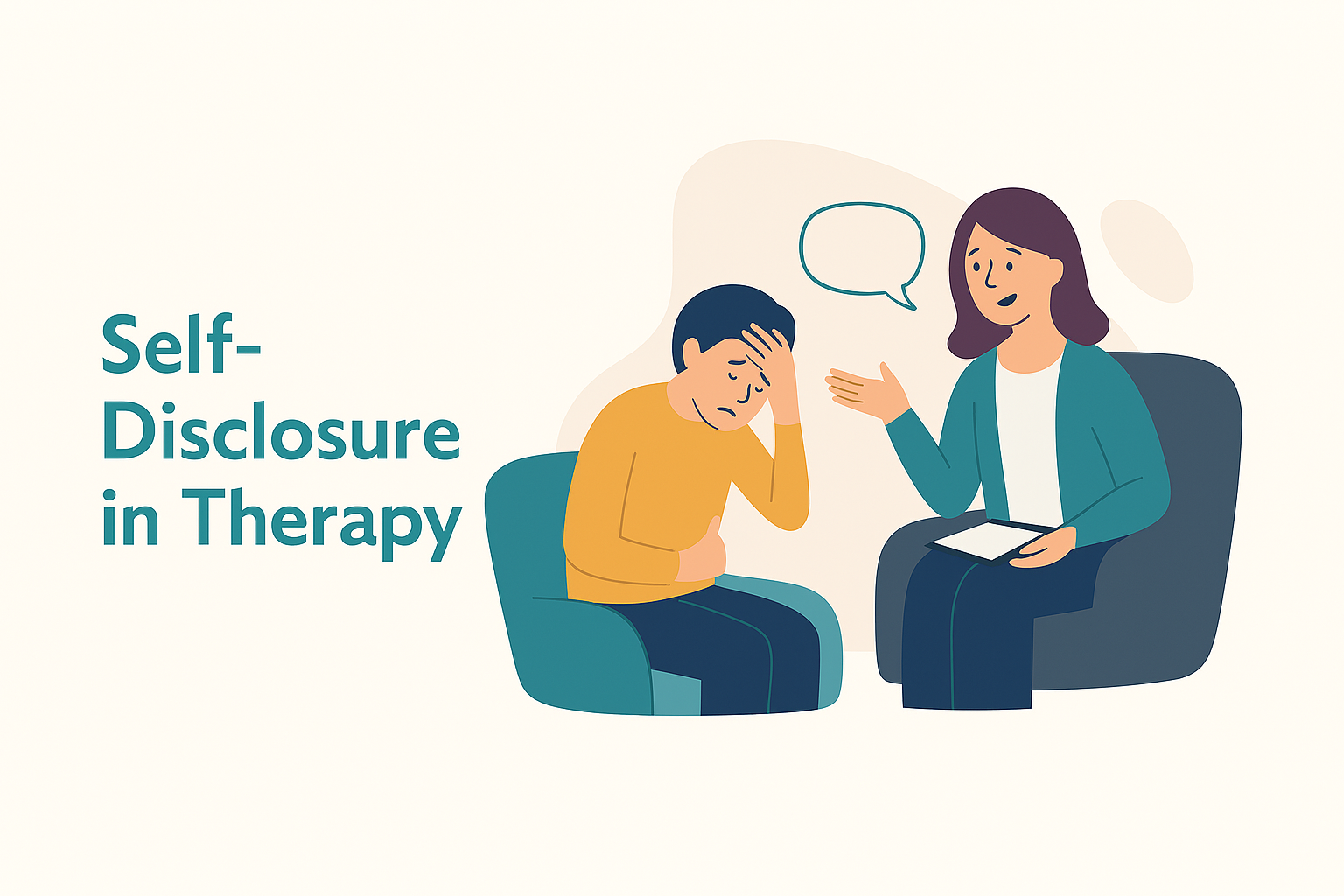
Therapist self-disclosure refers to moments when a therapist intentionally shares something about their own experiences, reactions, or perspectives during a therapy session.
In some therapeutic approaches, brief and thoughtful disclosure can strengthen the therapeutic relationship. However, when disclosures become lengthy or shift attention away from the client, they can blur professional boundaries.
Because of this, many training programs teach self-disclosure as an advanced clinical skill that requires careful judgment and supervision. Questions about authenticity and boundaries also connect to broader conversations about how therapy works and what makes a therapeutic relationship effective
It's common early in practice to feel curious about the boundaries of self-disclosure.
There’s a natural curiosity among emerging therapists to explore what it means to “show up” authentically in the therapy room. Self-disclosure can feel like an accelerant to connection—a way to bridge the gap between therapist and client, especially when the therapist is still forming their professional identity. But this eagerness can sometimes lead to blurred boundaries or disclosures which can unintentionally serve the therapist more than the client. It’s not about policing vulnerability—it’s about cultivating discernment.
It is hard not to engage in self-disclosure—we are human beings with rich histories and personal stories. We feel deeply for clients and empathize. This impulse is human, and part of why training emphasizes discernment.
This is the paradox of the therapeutic relationship: we are trained to be present, attuned, and empathic—but also to hold back. When a client shares something that resonates deeply with our own story, it’s almost instinctual to say, “Me too.” That impulse comes from a place of care, but if we act on it too quickly, we risk centering ourselves in the therapeutic conversation, which is a risk in any therapeutic relationship if we’re not mindful.”. The challenge is to stay grounded in the client’s narrative, even when our own is echoing loudly in the background.
Clients may interpret their experiences differently......
Even when the themes overlap—grief, trauma, identity—the meaning they make may be entirely different. If we jump in with our own story, we risk unintentionally overshadowing or invalidating their perspective when it doesn’t match our own. What feels like connection to us can land as disconnection for them.
This is one of the most subtle risks of self-disclosure: assuming that shared experience equals shared meaning. Even if the content is similar, the emotional landscape may be wildly different. When we disclose, we offer a lens. But if that lens feels too prescriptive or emotionally mismatched, the client may feel unseen or even judged. The intention may be connection, but the impact can be disconnection.
n most training models, self‑disclosure is treated as an advanced skill. Many clinicians find that the real skill lies in knowing when not to share. The urge to disclose can be powerful, but learning to pause, reflect, and redirect that energy into curiosity or attunement is what makes it therapeutic. Sometimes, the most impactful move is holding the story—not telling it.
Conceptualization turns the impulse to share into the discipline of restraint.
The urge to disclose becomes a signal—a reminder to pause and ask: Is this story serving the client’s growth, or is it meeting my own need for validation? If the answer isn’t clearly in service of the client, restraint is often the more therapeutic move. In this way, the instinct to share transforms into a tool for attunement, guiding us toward choices that keep the focus where it belongs: on the client’s process and goals.
This reflective pause is only the first step—conceptualization then asks us to filter the impulse through specific client factors. By examining demographics, motivation, clinical issues, and relational dynamics, we can determine whether disclosure truly supports the client’s process or risks shifting the focus away from their growth. The list below outlines these key considerations.
When Therapist Self-Disclosure Can Be Helpful
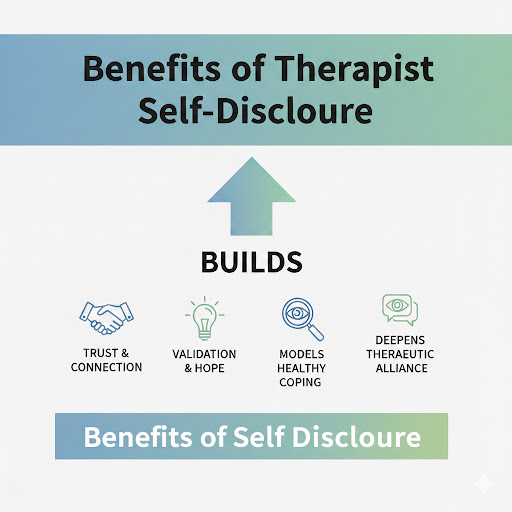
Some therapists find that carefully chosen self-disclosure can support therapy when it:
- normalizes a client’s experience
- strengthens the therapeutic alliance
- models emotional openness or reflection
- clarifies that a client is not alone in a particular struggle
In these situations, the disclosure is usually brief, relevant, and clearly connected to the client’s process.
Applying Conceptualization to Self Disclosure
Below are examples of factors many clinicians reflect on when considering self‑disclosure; they are not prescriptive rules, but prompts that can support thoughtful decision‑making.
Factor
Rationale & Clinical Question
Demographics & Group Status
Is the client part of a group shown to benefit more from self‑disclosure (e.g., teens, individuals with high relational mistrust)? For adolescents, brief, genuine disclosures could potentially reduce the “adult/expert” barrier and foster early rapport.
Client Motivation & Readiness
Has the client expressed hesitancy about being there? A small, strategic self‑disclosure may serve as an olive branch, building trust and rapport with a client who is questioning the value of therapy.
Specific Clinical Issue
Is the therapeutic issue one where self‑disclosure is an effective tool (e.g., shame, perfectionism)? When working with shame, sharing a similar, resolved experience where the therapist erred or struggled could provide powerful validation and buy‑in for the client to work through their own shame cycle.
Co‑dependency / People‑Pleasing
Does the client have a tendency to care‑take or people‑please? Self‑disclosure may evoke worry about the therapist’s wellbeing, triggering a care‑taking response. This risks breaking the therapeutic frame by shifting the client into the role of caretaker rather than recipient of care. The clinical question becomes: Will my disclosure burden the client or invite them to manage me, rather than focus on their own process?
Be authentic, not autobiographical: How to recognize real presence
Authenticity is about presence, not performance. Clients benefit when they feel their therapist is real, attuned, and human — but that doesn’t mean they need the therapist’s full story. The art lies in offering just enough of yourself to model openness, while keeping the spotlight firmly on the client’s journey. Autobiography risks shifting the focus away from the therapeutic process; authenticity keeps the frame intact while still allowing warmth and connection to shine through.
Self‑disclosure, then, is less about telling your story and more about using your humanity as a tool. When you share, let it be brief, purposeful, and client‑centered. When you hold back, let it be intentional, grounded in the belief that restraint can be just as powerful as disclosure.
When a therapist’s personal self enters the room in ways that feel too expansive, it risks a boundary crossing where the professional frame shifts towards a social dynamic, which can be detrimental. This shift can shape the therapeutic process in both helpful and harmful ways. On the positive side, it may foster trust and closeness. But on the negative side, over‑identification can place an unfair burden on the client. They may hesitate to share vulnerable details, worried about how you’ll perceive them or whether it will alter the image they believe you hold of them.
I once had a client describe how difficult it was to open up because they felt too aligned with their therapist. Instead of feeling free to explore, they became preoccupied with maintaining a certain image in the therapist’s eyes. This dynamic can also make clients reluctant to voice dissatisfaction with therapy or to consider ending the relationship, fearing it might hurt the therapist’s feelings. When that happens, the therapeutic alliance is compromised, and the client carries a responsibility that should never be theirs.
It’s important to remember that clients come to therapy precisely because it differs from friendship in important ways. In everyday relationships, conversations deepen through mutual self‑disclosure, with each person taking turns sharing more of themselves. Therapy is different. Clients seek a space where they can speak freely, without the expectation of reciprocity or the pressure to hold someone else’s story. They want the spotlight to remain on their experience, knowing the therapist’s role is to listen, reflect, and help them process. When we disclose too much of ourselves, we risk disrupting that unique dynamic and shifting the focus away from the very reason they came.

Authenticity in therapy isn’t about telling your story—it’s about bringing your self into the room.
Early in training, it can be tricky to recognize. Early in our careers, it’s easy to confuse self-disclosure with authenticity, as if sharing personal anecdotes is the only way to be real. But true authenticity is quieter. It’s felt in your tone, your posture, and even your pacing. It’s when your nervous system settles and you stop performing as “therapist” and start simply being one.
I often notice authenticity in myself when my voice sounds like it does with close friends—natural cadence, no performative polish. My body lets me soften into the chair, not sit bolt upright like I’m auditioning for clinical credibility. That shift doesn’t happen overnight. It’s something that develops over time, as the alliance deepens and I trust the relationship enough to bring my full presence.
Many clinicians think of this kind of authenticity as a subtle form of self‑disclosure… not of facts or stories, but of personality. It’s the “me” I bring into the room—the humor, the warmth, the quirks, the pauses. It is a manifestation of safe and effective use of self. Many therapists find that, when used appropriately, it can help clients feel safe, not because they know our histories, but because they can feel we are real.
Want to know more? I’ve include a few bonus reads for you below.
I’ve listed some core guildelines you could reflect on for safe self disclosure as well as a brief summary of some of the research on self disclosure to help you reflect and learn more. These reflections come from my own experience and supervision work, and are offered as considerations rather than prescriptions. Remember, The College of Registered Psychotherapists of Ontario (CRPO) does not prohibit self‑disclosure, but frames it as an advanced clinical skill requiring discernment. In practice, this could mean pausing to ask: Does this disclosure genuinely support the client’s process, or does it risk shifting attention to me? The resources below are meant to help you reflect during that pause as you naviagte your own professional path.
Looking for Support?
Figuring this out is hard! Knowing exactly how we are doing as therapists is even harder because of the nature of the work being behind closed doors. If you’re exploring your own approach to self‑disclosure or safe and effective use of self, support can be helpful.? Looking for an approachable mentor in developing your own therapeutic style that allows you to be authentically you in the therapy room while staying aligned with professional standards and ethical expectations.? Feel free to reach out if you’d like to explore supervision or consultation.
Amanda Carver, M.Ed., RYT-200 and EMDRIA Approved Consultant in Training is a Registered Psychotherapist practicing in Ontario since 2009. With a clinical focus on anxiety, stress and trauma, she works integratively with clients using a whole person, whole nervous-system lens and takes great pride in the mentorship and clinical supervision she provides to fellow therapists, emerging or established.
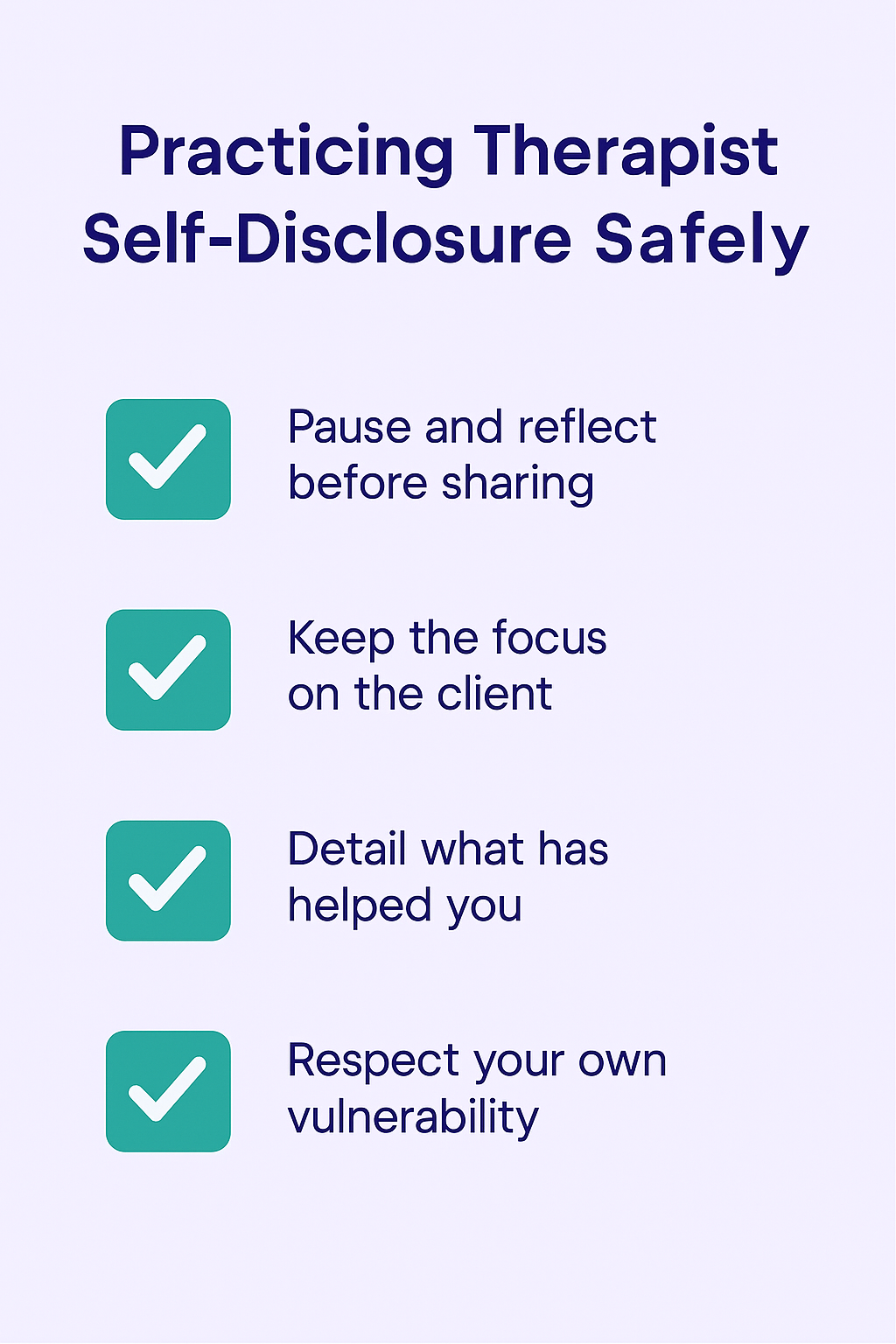
Core Guidelines for Safe Self-Disclosure
These are reflective prompts many clinicians use when thinking through self‑disclosure; they’re not rules or directives, but considerations that can support thoughtful decision‑making.
- Consider whether the impulse feels intentional or reactive
- Ask yourself: Why am I sharing this?
- does the disclosure supports the client’s therapeutic goals—not your own need for connection or validation?
- Consider the contents relevancy
- Is it directly related to the client’s experience or therapeutic theme?
- Does the tangent or personal anecdote shift focus away from the client?
- Consider how to maintain boundaries
- Does the disclosure model vulnerability or could it blur roles?
- Could sharing this disclosure make the client feel responsible for your emotions.
- Consider timing and dosage
- Does the timing of the disclosure risk feeling intrusive or confusing.
- Am I using it sparingly and strategically, especially with new or vulnerable clients.
- Am I being mindful of the client’s response
- Do I notice any signs of discomfort, confusion, or disengagement.
- Am I open to inviting reflections such as “How was it for you to hear that?” to gauge impact.
- If I choose to self disclose, does it require documentation or do I need to note my rationale
- Can I link back to how the disclosure relates to treatment goals, how did I gauge the client's reaction
- What therapeutic lens am I applying to the choice to self-disclose?
- Who can I consult when I'm unsure? Do I have a supportive space to explore motivations and potential impacts when uncertainty arises?
- Do I have a trusted supervisor or peer.
- Am I comfortable unpacking and exploring the motivations and potential consequences of the disclosure with my supervisor?
- More reflection questions.....
- Ask yourself questions such as
- “What purpose does this serve?”
- “How might this land for the client?”
- “Would I still share this if I weren’t feeling stuck or disconnected?”.
- Ask yourself questions such as
This content is for general educational purposes and is written is written with early‑career therapists in mind. It is not therapy, clinical guidance, or professional supervision, and it does not establish a therapeutic, supervisory, or consultative relationship. If you’re experiencing distress, please reach out to a qualified mental‑health professional. If you are in immediate distress or at risk of harm, in Canada you can call or text 9‑8‑8 or call 9‑1‑1; internationally, visit FindAHelpline.com for free, confidential support in your region.
Research Summary: Therapist Self-Disclosure
Therapist self-disclosure is a widely studied, high-impact intervention. Research overwhelmingly supports that its efficacy hinges on intentionality, timing, and brevity [Knox & Hill, 2017].
Pertinent Research Findings
- Strengthening the Alliance (Benefit):
- Appropriate, moderate self-disclosure—especially that which normalizes the client's experience or validates their feelings—is consistently associated with a stronger therapeutic alliance [Henretty et al., 2014]. This is a key predictor of positive treatment outcomes.
- Finding: Clients generally perceive brief, relevant disclosures as enhancing trust, empathy, and the therapist's human warmth [Audet & Everall, 2003].
- The Critical Role of Therapist Motivation (Risk/Practice):
- The therapist's motivation for disclosure is the primary differentiator between an effective intervention and a boundary violation. Disclosure driven by the therapist's own emotional needs (countertransference) is linked to negative outcomes and client dissatisfaction.
- Finding: Effective disclosure is always client-focused (designed to help the client feel understood), never therapist-focused (designed to satisfy the therapist's need to share) [Knox, 2008].
- Client Perception of Risk (Risk):
- Disclosure of current personal issues, or disclosures that are lengthy or irrelevant to the client's problem, are rated negatively by clients. These behaviors are often perceived as role reversal or monopolizing time, which severely damages the therapeutic frame.
- Finding: Disclosures that were too dissimilar to the client's experience were found to be unhelpful or even alienating, highlighting that relevance is paramount [Hill & Knox, 2009].
Select References and further sources
- Audet, D., & Everall, R. D. (2003). Therapist self-disclosure: A comparative study of the perceptions of male and female clients. Counselling and Psychotherapy Research.
- Henretty, J. R., et al. (2014). The role of therapist self-disclosure in psychotherapy: A review and new directions for research. Clinical Psychology Review.
- Hill, C. E., & Knox, S. (2009). Processing the alliance and client self-disclosure. Psychotherapy Research.
- Knox, S. (2008). Therapist self-disclosure. Psychotherapy: Theory, Research, Practice, Training.
- Knox, S., & Hill, C. E. (2017). Self-disclosure: Research, theory, and practice. John Wiley & Sons.
- Blueprint.ai – Ethical Self-Disclosure Guidelines
- Counseling Today – Encouragement or Impediment
- PositivePsychology.com – Self-Disclosure Examples
- Psychology Today – Opening Up
- Mental Health Academy – Ethical Therapist Self-Disclosure